 AI
AIThree Things in AI for Wednesday, October 7, 2026
First real edition. Three things, same three slots as promised in issue zero: what shipped, what it costs, who it changes the week for. Every item below links to the vendor's own page, read on the morning of October 7, 2026. One of today's three is for security teams only, one is for anyone with a developer on the payroll, and one is for everyone who has ever hit Save for later in Slack and then forgotten about it. Coffee first, then the three. ☕
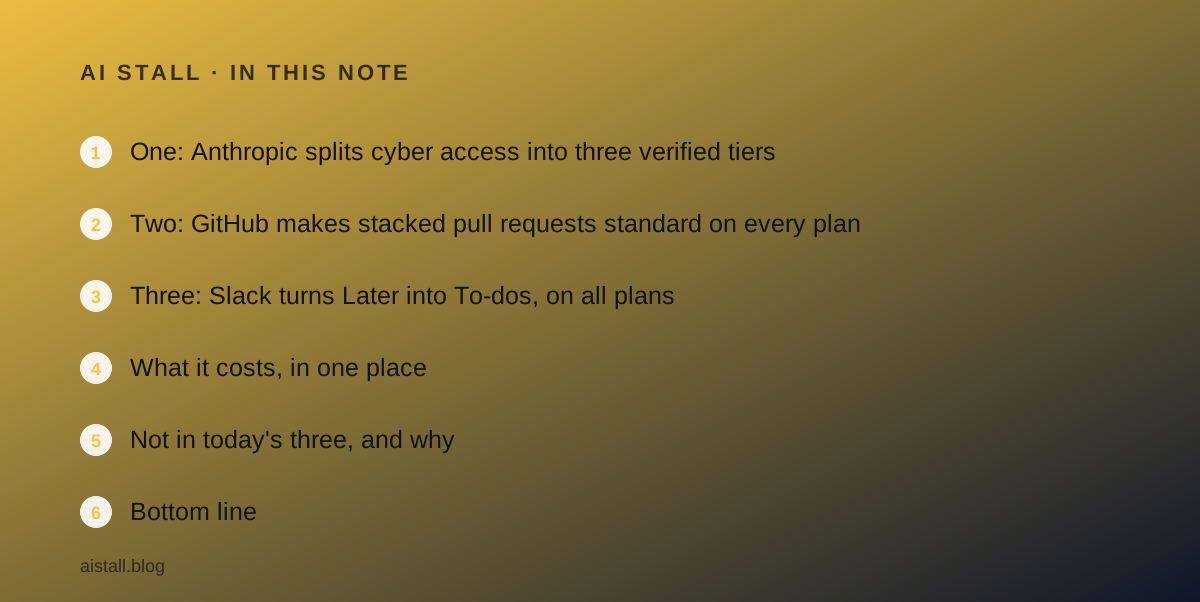
One: Anthropic splits cyber access into three verified tiers
What shipped. On October 6, 2026 Anthropic published an expansion of its Cyber Verification Program, described on [the announcement page](https://www.anthropic.com/news/cyber-verification-program) as giving qualified defenders advanced cyber capabilities and fewer safety blocks. There are now three tiers. Defense Access covers security operations, incident response, malware analysis and vulnerability research, and is open to company security teams, nonprofits, universities, government bodies, smaller security firms, open-source maintainers and individual researchers with a disclosure record. Red Team Access adds authorised penetration testing and is organisations only. Specialized Access, the tier with the fewest blocks, is reserved for verified organisations reviewed together with the US government. The page says Defense applications are reviewed within days and Red Team applications take weeks.
What it costs. The announcement does not publish a price for any tier, so the honest line is: price not published. The program runs on the Claude Platform, Google Cloud Vertex AI and Microsoft Foundry, with Amazon Bedrock limited to a narrower set of customers, per the same page. Who it changes the week for: a small company with no security function can skip this one entirely. A company that employs or contracts a security person, or an individual researcher who has ever filed a vulnerability disclosure, now has a defined door to knock on rather than a blocked prompt. The page also notes that data retention is required for monitoring, with a zero-retention exception for some existing enterprise customers, which matters if your client contracts forbid logging.
Two: GitHub makes stacked pull requests standard on every plan
What shipped. On October 6, 2026 GitHub's changelog announced that [stacked pull requests are generally available](https://github.blog/changelog/2026-10-06-stacked-pull-requests-generally-available/). A stack lets a developer split one large change into a chain of smaller pull requests that are reviewed one at a time and merged together. The changelog lists the practical details: approvals are preserved when unchanged code is rebased, signed commits survive the rebase, a deleted base branch retargets automatically, and keyboard shortcuts move you up and down the stack. Auto-merge for stacks is described as rolling out over the following weeks, so that specific piece is not on every account yet.
What it costs. The changelog says the feature is available on all github.com plans, which includes free accounts, and that it is coming to a future GitHub Enterprise Server release. No separate charge is listed. Who it changes the week for: any team where one developer regularly opens a pull request that the other developer dreads reviewing. GitHub's own figures on the page claim repositories using stacks merged nine percent more code than peers; treat that as a vendor number about vendor customers, not a promise about your team. The practical change is smaller and more certain: the next big refactor can be sent as five readable pieces instead of one unreadable one, with no new tool to install.
Three: Slack turns Later into To-dos, on all plans
What shipped. Slack's [October 2026 changelog](https://slack.com/changelog) lists an entry titled Later is now To-dos. Messages and files can be added as to-do items, which appear in a sidebar tab with reminders and completion tracking. A second entry in the same month explains where the old items went: anything previously archived under Later now lives in a Saved section of the Home tab. Both entries are marked as available on all plans. A third October entry, channel analytics inside channel details, is Enterprise only and applies to channels with 50 or more members, which rules out most readers of this brief.
What it costs. Nothing additional: the changelog marks To-dos and the Saved move as all plans, including free workspaces. Who it changes the week for: everyone on Slack, in a small way, starting with whoever had 40 items in Later and no memory of why. The one thing worth doing today is a thirty-second look at the Home tab to confirm your saved items survived the move, because people will ask in the channel and you will be the person who already looked. The September entries on the same page, passkey sign-in on Free, Pro and Business+ and focus mode synced to Google Calendar on all plans, are the two quiet ones worth switching on while you are there.
What it costs, in one place
- Anthropic Cyber Verification Program: price not published on the announcement; access is by application and tier, on the Claude Platform, Vertex AI and Microsoft Foundry.
- GitHub stacked pull requests: included on all github.com plans per the October 6 changelog; auto-merge for stacks still rolling out.
- Slack To-dos and the Saved section: all plans, no extra charge, per the October 2026 changelog. Channel analytics is Enterprise only.
Not in today's three, and why
Two things were close. Anthropic's October 2 announcement of a $100 million Claude Frontier Academy, which aims to train 10,000 deployed engineers by the end of 2027, is real money and a real program, but nominations come through an Anthropic account team or partner manager, per [the page](https://www.anthropic.com/news/claude-frontier-academy), and the first cohorts are from firms the size of Deloitte and Morgan Stanley. For a ten-person company it is news about someone else's week. GitHub also shipped a computer-use capability for Copilot on October 1 and a set of changelog items around Copilot code review on October 2; both sit behind a Copilot subscription and the changelog page gave less detail than a brief needs, so they wait until the documentation is fuller. Nothing from OpenAI appears today because its news page could not be read on the morning of October 7; the rule is primary source or nothing, and nothing it is.
Bottom line
If you run a small team and have five minutes: open Slack's Home tab and check your Saved items, then tell your developer that stacked pull requests are on, free, on your plan, and that the next large change should arrive as a stack. If you have a security person, forward them the Anthropic page and let them decide whether Defense Access is worth an application; it costs an email to find out and the price is not published anyway. Everything else today is either enterprise sized or waiting on a document that has not been written yet. Tomorrow, three more.