 AI
Embedding Prices Come in Four Different Units

Embeddings look like the simplest line on an AI bill. One number, per million tokens, no output column. Four rate cards read in one sitting show four different units and a ten-times spread.
This note reads the published embedding rates at OpenAI, Google, Voyage AI and Cohere, as the pricing pages showed them on November 3, 2026.
Two of the four do not put the figure in front of you. One collapses the rows; one keeps them behind a tab the page does not open by default.
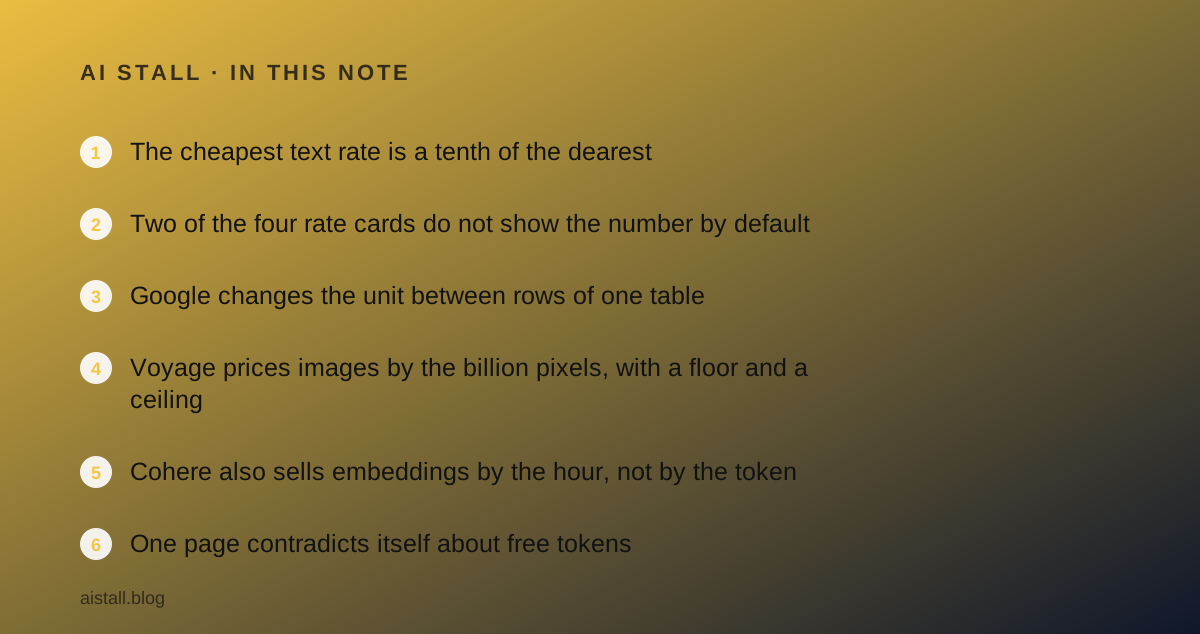
The cheapest text rate is a tenth of the dearest
OpenAI is the floor. text-embedding-3-small reads $0.02 per million input tokens and text-embedding-3-large reads $0.13, with no output or cached-input price.
Voyage AI matches the floor and tops out lower. voyage-4-lite reads $0.02 per million tokens, voyage-4 reads $0.06 and voyage-4-large reads $0.12.
Cohere sits between them. Embed 5 Fast reads $0.08 per million tokens and Embed 5 Pro reads $0.12, per the data behind its pricing page.
Google is the ceiling. gemini-embedding-001 reads $0.15 per million input tokens and the newer gemini-embedding-2 reads $0.20 for text.
So the newer Google model costs a third more for text than the model it succeeds, by editorial arithmetic on those two figures. Elsewhere the generational move runs the other way.
Voyage lists voyage-3-large at $0.18 under older models, against $0.12 for voyage-4-large. The current flagship is a third cheaper than the one before it.
OpenAI keeps a legacy row with the same shape. text-embedding-ada-002 reads $0.10, five times the price of the newer and smaller text-embedding-3-small.
Two of the four rate cards do not show the number by default
The OpenAI pricing page carries its embedding rows in the page data but marks them hidden. The specialised-models table lists Search, Embedding and Moderation as hidden model groups.
The figures appear only after expanding the table. A reader skimming the visible rows will not see an embedding price at all.
Cohere does something similar with tabs. Its pricing page opens on Workplace systems, where both products quote custom enterprise pricing and no rate.
Embed 5 and Rerank 5 rates sit behind the Advanced retrieval models tab, in the page data rather than on the opening view. The visible table is a different product entirely.
Google changes the unit between rows of one table
The gemini-embedding-2 table is headed Paid Tier, per 1M tokens in USD. Three of its four rows then quote a second unit in brackets.
- Text input: $0.20 per million tokens
- Image input: $0.45 per million tokens, or $0.00012 per image
- Audio input: $6.50 per million tokens, or $0.00016 per second
- Video input: $12.00 per million tokens, or $0.00079 per frame
The bracketed figures are conversions, and they imply the token counts. By editorial arithmetic they work out at about 267 tokens an image, 24.6 tokens a second of audio and 65.8 tokens a video frame.
The batch column halves every one of those eight numbers exactly. Text drops to $0.10, image to $0.225 and $0.00006, audio to $3.25 and $0.00008, video to $6.00 and $0.000395.
That consistency is worth something. The ratio between the two unit expressions survives the discount, which means the token counts behind them are fixed rather than estimated per request.
The same multimodal spread is what makes long audio expensive to index. Ten minutes of speech at 24.6 tokens a second is roughly 14,800 tokens before any text is involved.
Voyage prices images by the billion pixels, with a floor and a ceiling
The multimodal endpoint uses two units at once. Text is billed at $0.12 per million tokens and images at $0.60 per billion pixels, with each video frame treated as an image.
Both ends are clamped. Images under 50,000 pixels are upscaled and charged as 50,000-pixel images, and images over 2 million pixels are downsampled and charged as 2 million.
The page states the resulting bounds: a minimum of $0.00003 and a maximum of $0.0012 per image. Both follow from the pixel rate, and both check out.
The clamp has a blunt consequence in its own example table. A 2000 by 2000 image and a 4000 by 4000 image both cost $0.0012, because the larger one is downsampled first.
So quadrupling the pixels above the ceiling costs nothing extra and buys nothing extra. That is a resolution decision disguised as a pricing row.
Cohere also sells embeddings by the hour, not by the token
Its Model Vault table prices dedicated instances rather than usage. Embed 5 Fast and Embed 5 Pro both read $3.00 an hour at Small and $5.00 an hour at Medium.
The monthly column is not the hourly rate times the hours in a month. Small reads $2,000 a month and Medium reads $3,250.
A 730-hour month at $3.00 would be $2,190, so the monthly figure sits about 9 percent below it. At $5.00 the gap is about 11 percent, by editorial arithmetic on the published pairs.
The gap widens with instance size. Parse 5 at XL reads $7.00 an hour and $4,300 a month, about 16 percent below the hourly figure multiplied out.
On that table the two Embed tiers are priced identically. Fast and Pro cost the same per instance-hour, which is the opposite of the per-token table where Pro costs half again as much.
One page contradicts itself about free tokens
Voyage grants a large free allowance and says so twice in incompatible ways. The text embeddings section lists the first 200 million tokens as free for five named models, one of them voyage-code-3.
The older models table then lists voyage-code-3 at $0.18 per million tokens, under a heading stating that free tokens are not offered for those models.
The rerankers section repeats the pattern. It grants 200 million free tokens to rerank-2.5, rerank-2.5-lite, rerank-2 and rerank-2-lite, all four of which appear in the no-free-tokens table.
Both readings are on the page, read November 3, 2026. Treat the free allowance for those specific older models as unconfirmed and check the balance in the console before planning around it.
One exclusion is stated without ambiguity. Free token credits do not apply to Batch API usage, and batch tokens are billed at the discounted rate rather than drawn from the free balance.
What is not on the embedding row
- Storage: Voyage bills uploaded files at $0.05 per GB per month and deletes them after 30 days
- Reranking: a separate endpoint at $0.05 per million tokens for rerank-3, $0.02 for rerank-3-lite
- Reranker token maths: query tokens multiplied by document count, plus every document's tokens
- Batch windows: Voyage offers a 33 percent discount on a 12-hour completion window
- Data terms: Google's free embedding tier is marked as used to improve our products, the paid tier is not
- Parsing: Cohere bills document parsing separately at $1.50 per 1,000 pages
The reranker formula deserves a second look. Processed tokens are the query tokens times the number of documents, plus the sum of all document tokens, so a hundred-document search bills the query a hundred times.
Cohere defines the other half of that: a single search unit is one query with up to 100 documents to be ranked. The document count is the variable that moves the bill.
Bottom line
Text embeddings run from $0.02 to $0.20 per million tokens across these four vendors, a ten-times spread for a line most cost models treat as a rounding error.
The unit matters more than the rate. Per million tokens, per image, per second, per frame, per billion pixels and per instance-hour all appear on these four pages.
Indexing the same corpus twice is the usual way this bill surprises people, and chunk overlap is why: see the cached-input price is the one that matters.
Batch routes halve the rate here as they do for generation, on the same terms described in the fifty percent discount you have to ask for.
How much text a window holds decides how much you need to embed in the first place, which is covered in what a million-token window actually holds.
Free allowances end at a spending ceiling rather than a feature wall: see the monthly cap on a new API account.
A custom embedding model carries the same standing charge as any other tuned endpoint, described in the fine-tune you keep paying rent on.
For the order to read a new retrieval account's limits in, see how to size an AI API account before you pay and the retention terms in what the AI vendors say they keep.
Sources
- OpenAI API pricing (specialised models, hidden embedding rows) - checked November 3, 2026
- Gemini API pricing (Gemini Embedding 2 and Gemini Embedding) - checked November 3, 2026
- Voyage AI pricing (text, multimodal, rerankers, batch, older models) - checked November 3, 2026
- Cohere pricing (Embed 5, Rerank 5, Model Vault instance rates) - checked November 3, 2026