 AI
The Per-Minute Transcription Price Is an Estimate
A transcription rate card is only comparable once you fix the unit. One vendor prices by the minute, one by the hour, one by the token, and one prints a per-minute figure it calls an estimate.
This note reads the published speech-to-text rates at OpenAI, Google, Deepgram, AssemblyAI and Cohere, as the pricing pages showed them on November 3, 2026.
No two of the five use the same billing unit. Three publish two units on the same row, and in two cases the second unit is arithmetic rather than a rate.
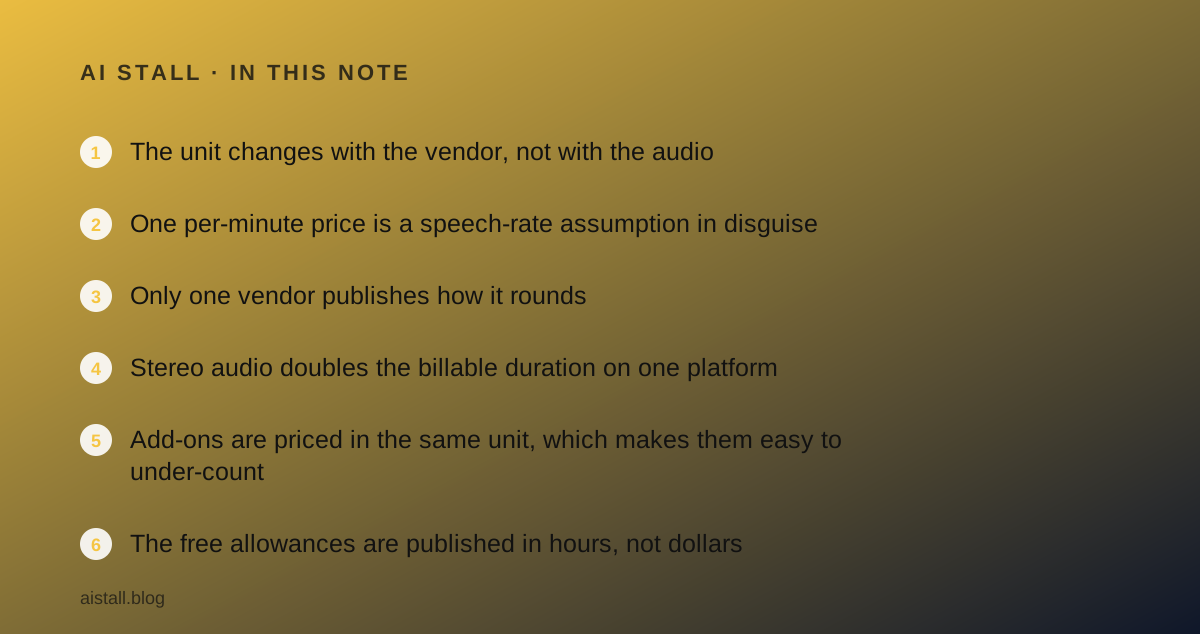
The unit changes with the vendor, not with the audio
AssemblyAI prices every speech product by the hour. Pre-recorded Universal-3.5 Pro reads $0.21 an hour and Universal-2 reads $0.15, per the pricing page checked November 3, 2026.
Deepgram prices by the minute. On Pay as you go, Nova-3 Monolingual streaming reads $0.0077 a minute and Nova-3 Multilingual reads $0.0092.
OpenAI publishes a token table with a column headed Estimated cost. gpt-4o-transcribe reads $2.50 input and $10.00 output per million tokens, and $0.006 a minute.
Google publishes both units in one cell. Gemini 3.5 Transcribe reads $2.00 or $0.003 a minute for audio input, and $12.00 or $0.002 a minute for text output.
Cohere lists a model called Transcribe on its pricing page under the unit label 1M tokens. The card carries no figure, so the rate could not be read on November 3, 2026.
Converted to one minute, by editorial arithmetic on those published rates, the order is not what the headline numbers suggest.
- AssemblyAI Universal-2, pre-recorded: $0.15 an hour, or $0.0025 a minute
- AssemblyAI Universal-3.5 Pro, pre-recorded: $0.21 an hour, or $0.0035 a minute
- Deepgram Nova-3 Monolingual, pre-recorded: $0.0043 a minute, or $0.258 an hour
- OpenAI gpt-transcribe: $0.0045 a minute, or $0.27 an hour
- Google Gemini 3.5 Transcribe, blended: about $0.005 a minute, or $0.30 an hour
- Deepgram Nova-3 Monolingual, streaming: $0.0077 a minute, or $0.462 an hour
Streaming is the expensive half everywhere, but the gap is vendor-specific. Deepgram's streaming figure is about 3.1 times AssemblyAI's Universal-Streaming rate of $0.15 an hour.
One per-minute price is a speech-rate assumption in disguise
Google says so in a footnote, which is the most useful sentence on any of the five pages. Its per-minute figures are estimates, not rates.
The footnote states the assumptions: 25 audio tokens per second for input and 175 text tokens per minute for output, for an effective blended rate of about $0.005 per minute for Transcribe.
Both halves check out. Twenty-five tokens a second is 1,500 a minute, which at $2.00 per million is $0.003. The output assumption at $12.00 per million is $0.0021.
The second assumption is the fragile one. A speaker producing more than 175 text tokens a minute costs more than the printed estimate, and nothing on the page caps that.
Transcribe Live applies the same two assumptions to higher rates. Input reads $3.50 or $0.005 a minute, output $21.00 or $0.004, blended at about $0.009 a minute.
OpenAI uses the same device without showing its working. Two of its six transcription rows carry token prices and a per-minute figure; four carry a per-minute figure and dashes for input and output.
Only one vendor publishes how it rounds
Deepgram puts it on the page twice. Billing is per second of processed audio with no block-based rounding for normal audio requests, and there is no minimum duration.
Its FAQ repeats the rule in plain terms, saying a 14-second file bills as 14 seconds. That is the only rounding statement among the five pages read here.
OpenAI publishes a rounding rule for voice sessions rather than for transcription. GPT-Live voice sessions are billed per second without rounding up to a whole minute, and gpt-live-1 reads $0.05 a minute.
OpenAI also publishes a minimum, for a different product on the same page. Code interpreter container sessions are billed by the minute with a five-minute minimum per session.
The AssemblyAI pricing page carries no statement about rounding or a minimum billable duration, read November 3, 2026. That is a gap in the page, not a claim about how the vendor actually bills.
Stereo audio doubles the billable duration on one platform
Deepgram states that multichannel audio bills by total processed duration across channels. Its FAQ spells out the consequence: a ten-minute stereo file contains twenty minutes of audio and bills as twenty.
That doubles the cost of any two-track call recording, which is how most contact centre audio arrives. No other page read here mentions channel counting at all.
Add-ons are priced in the same unit, which makes them easy to under-count
The headline rate buys a transcript and little else. Four Deepgram streaming add-ons each carry their own per-minute price on top of transcription.
- Redaction: $0.0020 a minute on Pay as you go
- Speaker Diarization: $0.0020 a minute
- Entity Detection: $0.0017 a minute
- Keyterm Prompting: $0.0013 a minute
- Smart Formatting: included at no cost
Those four together add $0.0070 a minute to a $0.0077 base, a 91 percent increase by editorial arithmetic on the published figures.
AssemblyAI stacks the same way in hours. Speaker diarization on a realtime stream costs $0.12 an hour on top of a $0.15 model, an 80 percent increase on the base rate.
Its Dictation API is the exception and says so. Every feature is included in the $0.62 an hour rate, with one line on the bill and no second rate to model.
Two of its pre-recorded add-ons are free on the cheaper model and charged on the dearer one. Keyterms Prompting reads Included on Universal-2 and $0.05 an hour on Universal-3.5 Pro.
The free allowances are published in hours, not dollars
AssemblyAI says the free tier includes up to 185 hours of pre-recorded transcription and up to 333 hours of streaming transcription.
Those two numbers imply different credit values. At $0.15 an hour, 333 streaming hours is about $50, while 185 pre-recorded hours is about $28 at that rate and about $39 at $0.21.
The page publishes no dollar figure for the free tier, so neither allowance can be reconciled against the rate card. Confirm the balance in the console rather than from the page.
Deepgram publishes both the credit and the hours. The $200 free credit is described as roughly 43,000 minutes, over 700 hours, of Nova-3 transcription.
That holds for pre-recorded audio and not for streaming. At the $0.0043 pre-recorded rate it is about 46,500 minutes; at the $0.0077 streaming rate it is nearer 26,000.
What to settle before a transcription contract
- Which unit the contract prices in, because a per-hour page and a per-minute page cannot be compared as printed
- Whether a per-minute figure is a rate or an estimate derived from assumed token counts
- What the vendor says about rounding and minimum duration, which only one of these five pages addresses
- Whether stereo or multi-track audio doubles the billable duration
- Which features are add-ons carrying their own per-minute or per-hour price
- Whether the free allowance is published in dollars, in hours, or both, and whether the two agree
Overage terms belong on that list too. Deepgram says exceeding Growth credits bills at the Growth rate plus 10 percent, charged weekly on Mondays, and returns a 402 with no card on file.
Bottom line
Converted to a single minute, these published rates sit between $0.0025 and $0.0077, a spread of about three times across pre-recorded and streaming work.
The per-minute number is the one to distrust. On two of the five pages it is labelled an estimate, and on one of them the assumptions behind it are printed in full.
Add-ons move the real figure more than model choice does, which is the same pattern as the add-on that is not in the seat price.
Audio also fills a context window faster than text, which matters for long files: see what a million-token window actually holds and the price changes partway through the prompt.
The free tiers here are free in money and not always in data. What each vendor reserves the right to keep is in what the AI vendors say they keep.
Batch routes cut token rates in half but do not apply to these per-minute products: see the fifty percent you get for waiting.
Throughput, not price, is what usually breaks a transcription pipeline first. That sits in rate limits are the real tier difference.
For the order to read a new account's limits in, start with how to size an AI API account before you pay, and check the expiry dates flagged in the introductory price is not the price.
Sources
- OpenAI API pricing (transcription models, GPT-Live sessions) - checked November 3, 2026
- Gemini API pricing (Gemini 3.5 Transcribe and Transcribe Live) - checked November 3, 2026
- Deepgram pricing (speech-to-text rates, add-ons, FAQ) - checked November 3, 2026
- AssemblyAI pricing (per-hour models and add-on features) - checked November 3, 2026
- Cohere pricing (Transcribe card, unit label without a figure) - checked November 3, 2026