 AI
The Introductory Price Is Not the Price

The number on the pricing card is often a temporary number, and the vendors say so if you read far enough down. Google Workspace discounts the first twelve months for the first twenty users. Microsoft's Copilot add-on discount closes on December 31, 2026 and only applies to annual billing. Gemini Flash has a dated price rise printed inside the rate itself. This note collects the four expiry clauses we could read on October 12, 2026 and works out what each one costs in year two. Every figure comes from a vendor pricing page, with the arithmetic marked where it is ours.
Four different ways a price expires
The clauses are not variations on one trick. Each one ends the discount by a different mechanism, which means each one needs a different diary entry.
- A time limit: the discount lasts twelve months, then the standard rate applies
- A seat cap: the discount covers the first twenty users only, whatever the headcount
- A dated rate rise: the published price itself changes on a stated calendar date
- A billing condition: the discount exists on annual commitment and vanishes on monthly
All four are disclosed. None of them is on the large type.
Google Workspace: twelve months, twenty seats
The Workspace pricing page, checked October 12, 2026, lists Business Starter at $3.50 per user per month as 50 percent off for twelve months, against a standard $7.00. Business Standard is $8.40 as 40 percent off twelve months, against $14.00.
Business Plus is listed at $22.00 with no introductory discount shown, and Enterprise is quote-only. Starter, Standard and Plus each carry a maximum of 300 users; Enterprise lists no minimum or maximum.
The condition sits under the cards. Introductory pricing applies to the first twenty users added, for twelve months, and all plans are billed monthly with a fourteen day no-cost trial.
Arithmetic by this desk on those published rates: a ten person team on Business Standard pays $1,008 in year one and $1,680 in year two at the standard rate. The same work costs 67 percent more at month thirteen.
The seat cap bites earlier for bigger teams. A twenty five person team gets the introductory rate on twenty seats and the standard rate on five from day one.
Microsoft: the discount lives on the annual commitment
The Copilot for business pricing page lists the Microsoft 365 Copilot Business add-on at $18.00 per user per month paid yearly, shown as reduced from $21.00, and at $25.20 per user per month on monthly billing.
Our arithmetic on those three figures: $25.20 is exactly 1.2 times $21.00. Microsoft's monthly uplift is 20 percent across its plan cards, and it is applied to the undiscounted annual rate.
So monthly billing costs 40 percent more than the discounted annual rate, not 20 percent. The flexibility premium and the forfeited discount arrive together.
The footnote dates the offer: available between July 1, 2026 and December 31, 2026, annual commitment required, promotional pricing applies to the first year only, and a seven day cancellation window for a prorated refund.
We mapped the rest of Microsoft's current naming and prerequisites in a separate note, because the price is only readable once you know which add-on family applies.
Gemini Flash carries its own rate rise
Google's Gemini API pricing page does something unusual and welcome: it prints the future price next to the current one. Gemini 3.8 Flash input is listed at $0.75 per million tokens through December 31, 2026, then $1.50 from January 1, 2027.
Output follows the same pattern at $3.75 then $7.50, and context caching at $0.075 then $0.15. Gemini 3.6 Flash is listed with the same pair of rates.
That is a published doubling with eleven weeks notice at the time of writing. Any cost model built on the current Flash rate needs a second column for January.
It also changes the comparison across vendors. At $1.50 input, Flash sits well above the ten cent small-model tier we covered in the Haiku pricing brief, where it currently sits closer.
Monthly billing is the quiet surcharge everywhere
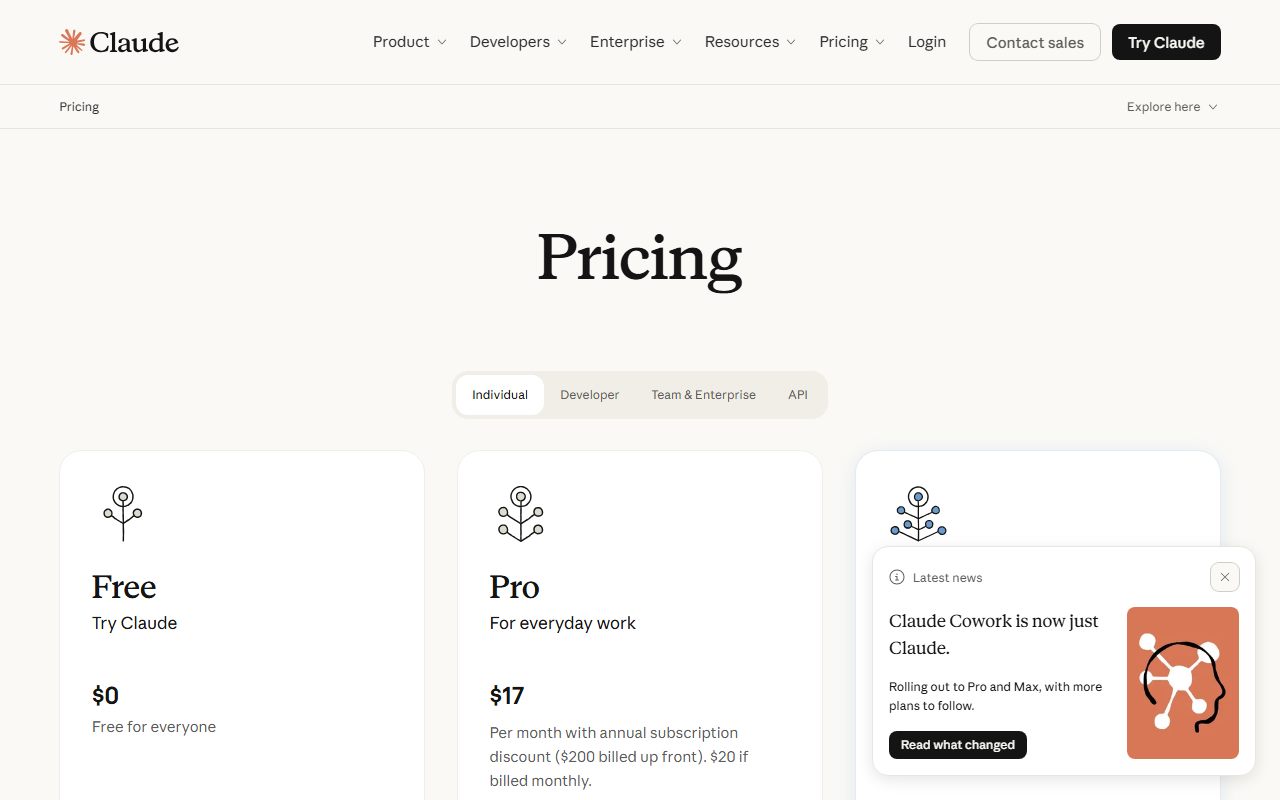
Anthropic's pricing page, checked October 12, 2026, lists Claude Pro at $17 per month on annual billing and $20 monthly, and the Team standard seat at $20 per seat per month annual against $25 monthly.
Our arithmetic: that is 17.6 percent more for Pro and 25 percent more for a Team seat. Microsoft's uplift is 20 percent. Nobody charges the same for the privilege of leaving.
The same page lists the Team premium seat at $100 per seat per month annual or $125 monthly, described as 5 times more usage than a standard seat, and Team as being for teams of two to 150.
Enterprise is listed at $20 per seat per month billed annually, with usage cost scaling with model and task. A per-seat figure with a usage tail attached is not a per-seat figure, and it should not be compared with one.
What to put in the renewal calendar
- Month thirteen of any Workspace subscription, when the introductory rate ends
- The twenty first seat, which is where Workspace introductory pricing stops applying
- December 31, 2026, when Microsoft's published Copilot discount window closes
- January 1, 2027, when Gemini 3.8 Flash and 3.6 Flash list double their current rates
- Any renewal where someone is paying monthly: that is 17.6 to 40 percent of the bill, depending on the vendor
Seat plans are only half the bill once a team starts building things. The other half is covered in the cached-input note and the batch discount note.
Two more questions belong in the same review: what the vendor keeps, in this note, and when the model behind the plan gets switched off, in the shutdown calendar.
Bottom line
Price a tool at the rate you will pay in month thirteen, on the number of seats you expect to have, at the billing cadence you actually want. Every discount above has a published end, and most of them end within fifteen months.
For plan-by-plan detail on the three assistants, see our reviews of ChatGPT Business, Claude Team and Microsoft 365 Copilot Business, the guide for small teams, and the head to head comparison.
Sources
- Google Workspace pricing page - checked October 12, 2026
- Microsoft Copilot for business, pricing page - checked October 12, 2026
- Gemini API pricing - checked October 12, 2026
- Claude pricing page - checked October 12, 2026