 AI
Rate Limits Are the Real Tier Difference

Paid API tiers rarely unlock a feature. What they change is how fast an account is allowed to go.
This note records the published throughput limits for the three large platforms, read from the documentation source on October 27, 2026.
Two vendors print full tables. The third has moved its per-model figures into a signed-in console, which changes what a buyer can compare in advance.
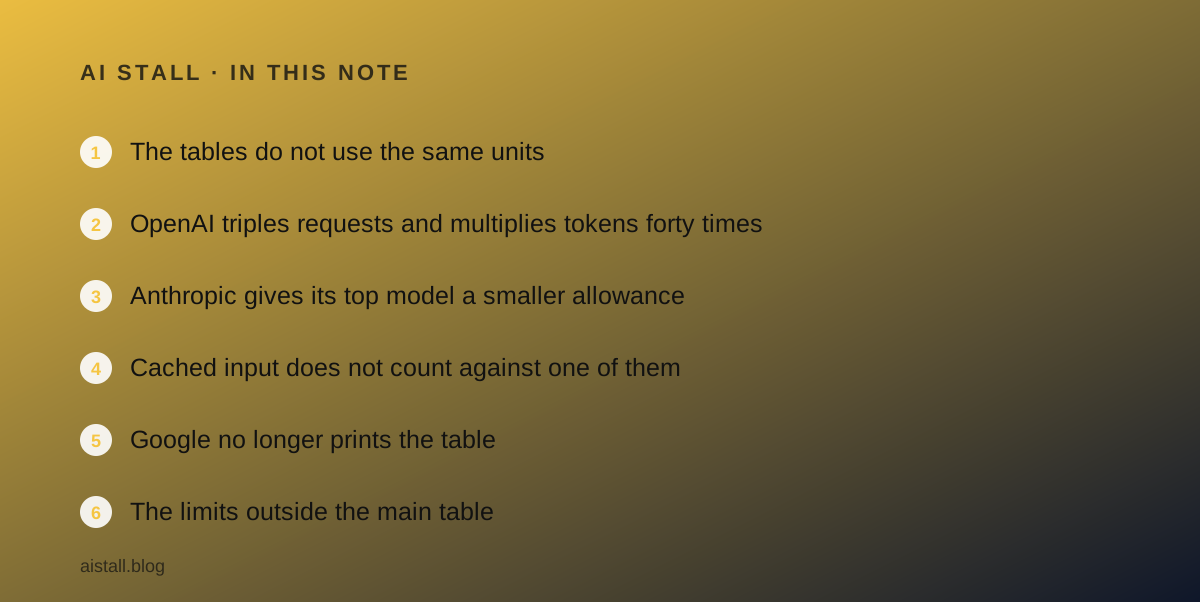
The tables do not use the same units
Before comparing, it is worth noting that the dimensions differ. OpenAI measures RPM, RPD, TPM, TPD, IPM and, for some streaming audio models, audio minutes per minute.
Anthropic measures requests per minute, input tokens per minute and output tokens per minute as three separate limits on each model class.
Google measures requests per minute, input tokens per minute and requests per day, with images per minute for image models and a token-per-day limit on some others.
A single tokens-per-minute figure and a split input and output pair are not the same measurement. Comparing them directly overstates whichever vendor publishes one combined number.
OpenAI triples requests and multiplies tokens forty times
OpenAI's standard rate limits table lists its three paid tiers, Build, Launch and Grow, with figures grouped by model name.
- Build: Astra, Sol and Terra at 5,000 RPM and 1,000,000 TPM; Luna at 5,000 RPM and 2,000,000 TPM
- Launch: Astra, Sol and Terra at 10,000 RPM and 4,000,000 TPM; Luna at 10,000 RPM and 10,000,000 TPM
- Grow: Astra, Sol and Terra at 15,000 RPM and 40,000,000 TPM; Luna at 30,000 RPM and 180,000,000 TPM
The two columns move at very different rates. Requests per minute triple from Build to Grow on the flagship models. Tokens per minute rise forty-fold.
That ratio is editorial arithmetic from the published figures. It says something useful: the upper tiers are sold to workloads with long prompts, not to workloads with many short ones.
The cheap model gets the steepest curve. Luna runs from 2,000,000 TPM at Build to 180,000,000 at Grow, which is ninety times the starting allowance.
The tier qualifications behind these numbers are cumulative credit purchases of $5, $100 and $500, as recorded in the monthly cap note.
Anthropic gives its top model a smaller allowance
Anthropic's tables are per model class and per tier, with three numbers in every row. The Start tier figures for the current mainstream models are identical.
Claude Opus 5.5, Sonnet 5.5 and Haiku 5.5 each get 1,000 RPM, 2,000,000 input tokens per minute and 400,000 output tokens per minute at Start.
Build raises all three to 5,000 RPM, 5,000,000 ITPM and 1,000,000 OTPM. Scale raises them again to 10,000 RPM, 10,000,000 ITPM and 2,000,000 OTPM.
Claude Fable 5.1, the model the page recommends for demanding reasoning, is the exception in every tier. It gets less.
- Start: 1,000 RPM, 500,000 ITPM, 100,000 OTPM
- Build: 2,000 RPM, 1,500,000 ITPM, 300,000 OTPM
- Scale: 4,000 RPM, 4,000,000 ITPM, 800,000 OTPM
At Scale the gap is clear: 4,000,000 ITPM for Fable against 10,000,000 for Opus 5.5. The most capable model is also the most rationed, which is a capacity statement rather than a pricing one.
A footnote adds that the Fable limit is a combined total across Claude Fable 5.1 and Claude Fable 5, with Mythos models sharing a separate combined bucket on the same terms.
Cached input does not count against one of them
The most consequential line in the Anthropic rate limit page is not in a table. For most Claude models, only uncached input tokens count toward the ITPM limit.
The page is explicit about which fields count. Fresh input tokens and cache creation tokens count. Cache read tokens do not, for most models.
Anthropic gives its own worked example: with a 2,000,000 ITPM limit and an 80 percent cache hit rate, an organisation could effectively process 10,000,000 total input tokens per minute.
That turns prompt caching into a throughput lever as well as a price lever. The price side is covered in the cached-input price note.
One older model is carved out. Claude Haiku 3.5 does count cache read tokens toward its ITPM, per the footnote under the tables.
Output is measured differently again. OTPM counts tokens as they are produced, and the max_tokens parameter does not factor in, so setting a high ceiling carries no rate-limit penalty.
Google no longer prints the table
The Gemini API rate limits page still has a section headed Gemini API rate limits. Read on October 27, 2026, that section carried no per-model figures.
In their place is a sentence saying limits depend on factors such as usage tier and can be viewed in Google AI Studio, followed by a link to the signed-in view.
The page is not empty of numbers. It publishes spend-based limits, tier qualifications, batch figures and the note that priority inference defaults to 0.3x the standard rate limit for each model and tier.
What is missing is the one table a buyer would use to compare Google against the other two before opening an account. This brief treats that as unreadable rather than unpublished.
Two smaller facts from the same page are worth keeping. Limits apply per project rather than per API key, and requests-per-day quotas reset at midnight Pacific time.
The limits outside the main table
Each vendor runs separate budgets for anything that is not a plain chat request. These are easy to miss because they sit below the headline tables.
- Anthropic Message Batches: Start allows 200,000 batch requests in the processing queue, Build 300,000 and Scale 500,000, with 100,000 per batch at every tier
- Anthropic Managed Agents: 300 requests per minute for create endpoints and 1,200 for read endpoints, separate from Messages API limits
- OpenAI vector stores: file and file-batch ingestion share 300 requests per minute for each vector store ID
- OpenAI long context: models such as GPT-5.5 carry a separate rate limit for long context requests, visible only in the developer console
- Google Batch API: 100 concurrent batch requests, a 2GB input file limit and a 20GB file storage limit, plus per-model enqueued token caps by tier
- Anthropic acceleration limits: a sharp increase in usage can return 429 errors even below the published ceiling
The batch numbers are large enough to matter in the other direction. A Scale tier account can hold half a million batch requests in a queue, which is a different planning problem from a per-minute limit.
Bottom line
Throughput, not features, is what the paid tiers sell. OpenAI's flagship allowance runs 1,000,000 to 40,000,000 TPM across three tiers. Anthropic's runs 2,000,000 to 10,000,000 ITPM.
The two numbers are not interchangeable, because one platform excludes cached reads from the limit and the other publishes a single combined figure.
Google's own per-model table is behind a sign-in as of October 27, 2026, so a like-for-like comparison before signing up is not available.
For the window these tokens fill, see the million-token window note. For what they cost once a prompt gets long, see the long-context price note.
The batch route that halves the rate is in the fifty percent discount note.
Teams buying a coding tool rather than raw tokens should start with the Cursor review and the shortlist of AI assistant plans.
What this brief prints and what it cuts is in issue zero.
Sources
- OpenAI rate limits guide (standard rate limits table) - checked October 27, 2026
- Anthropic rate limits documentation (per-tier tables and cache-aware ITPM) - checked October 27, 2026
- Gemini API rate limits - checked October 27, 2026