 AI
ChatGPT Business vs Claude Team for small teams (2026)
Two team plans, one price. ChatGPT Business and Claude Team both sell a standard seat at $20 a month billed annually or $25 monthly, and a premium seat at $100 or $125 with five times the usage, per both vendors' pricing pages checked October 10, 2026. Both refuse to train on your data by default and both include SSO. The differences are at the edges: ChatGPT Business allows 200 seats and includes the Office and Google Sheets extensions; Claude Team stops at 150 but adds up to $500 a month in pooled API credits and Claude Code on every seat. Short answer: ChatGPT Business for a general office team, Claude Team for a team with developers or heavy document work. This is a documentation comparison; no workspace was created.
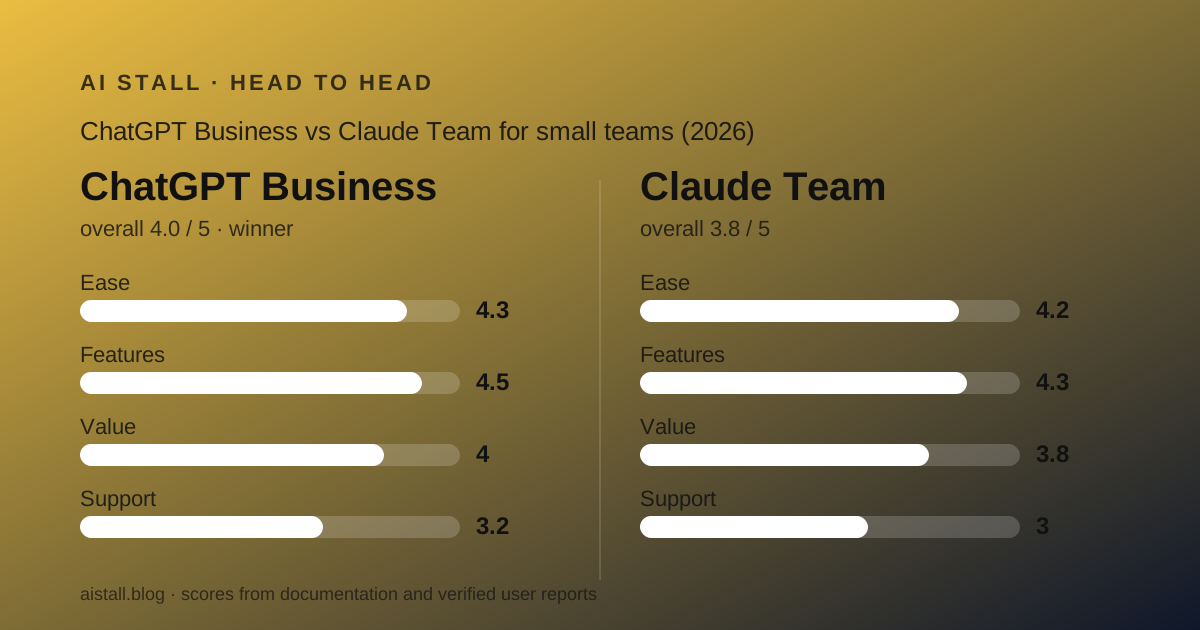
 4.0ChatGPT Business
 3.8Claude Team
Specification by specification
| Spec | ChatGPT Business | Claude Team |
|---|---|---|
| Standard seat, annual billing | $20/seat/mo | $20/seat/mo |
| Standard seat, monthly billing | $25/seat/mo | $25/seat/mo |
| Premium seat | $100 annual, $125 monthly, 5x usage, no 5-hour limit | $100 annual, $125 monthly, 5x usage |
| Seat range | 2 to 200 | 2 to 150 |
| Pooled API credits | Not listed | Up to $500/mo |
| Coding agent | Codex included | Claude Code included |
| Published message quota | Vendor does not publish | Vendor does not publish |
| Context window stated | 54K instant, 256K reasoning | Vendor does not publish on Team page |
| Training on your data | No, by default | None by default |
| SSO | SAML SSO and MFA | SSO and domain verification |
| SCIM, role-based access, audit logs | Enterprise only | Enterprise only |
| Trial | Not listed | Not listed |
| Payment | Card; invoicing on Enterprise | Card only; ACH and invoicing on Enterprise |
| Public review signal | Trustpilot 1.3/5, 1,238 reviews (unclaimed, consumer-wide) | Trustpilot 1.5/5, 2,042 reviews (unclaimed); Gartner 4.6/5, 103 ratings |
The short answer
This is a documentation comparison. It uses OpenAI's business pricing page and plan comparison table, Anthropic's pricing page and Team plan page, and the public review profiles named below, all checked October 10, 2026. No workspace was opened on either side. The single-product pages are ChatGPT Business and Claude Team.
ChatGPT Business wins, narrowly, for the typical small office team. The price is identical, the seat ceiling is higher at 200, the Office and Google Sheets extensions are included, and the comparison table publishes context windows and page limits that Anthropic's Team page does not.
Claude Team wins the case its page is built for: a team with developers or long-document work. Up to $500 a month in pooled API credits and Claude Code on the standard seat are things ChatGPT Business does not list, and the Team page names its missing admin controls in writing.
Both share the same two weaknesses. Neither vendor publishes a message quota for a standard seat, and both have poor public support records on Trustpilot, with the caveat that both profiles are unclaimed and consumer-heavy.
- ChatGPT Business is best for: general office teams of 2 to 200, Microsoft and Google document users, teams that want the broadest feature table at $20 a seat
- Claude Team is best for: teams of 2 to 150 with developers, legal or research work in long documents, and anyone who will spend the pooled API credits
Pricing: identical at every seat count up to 150, then only one option
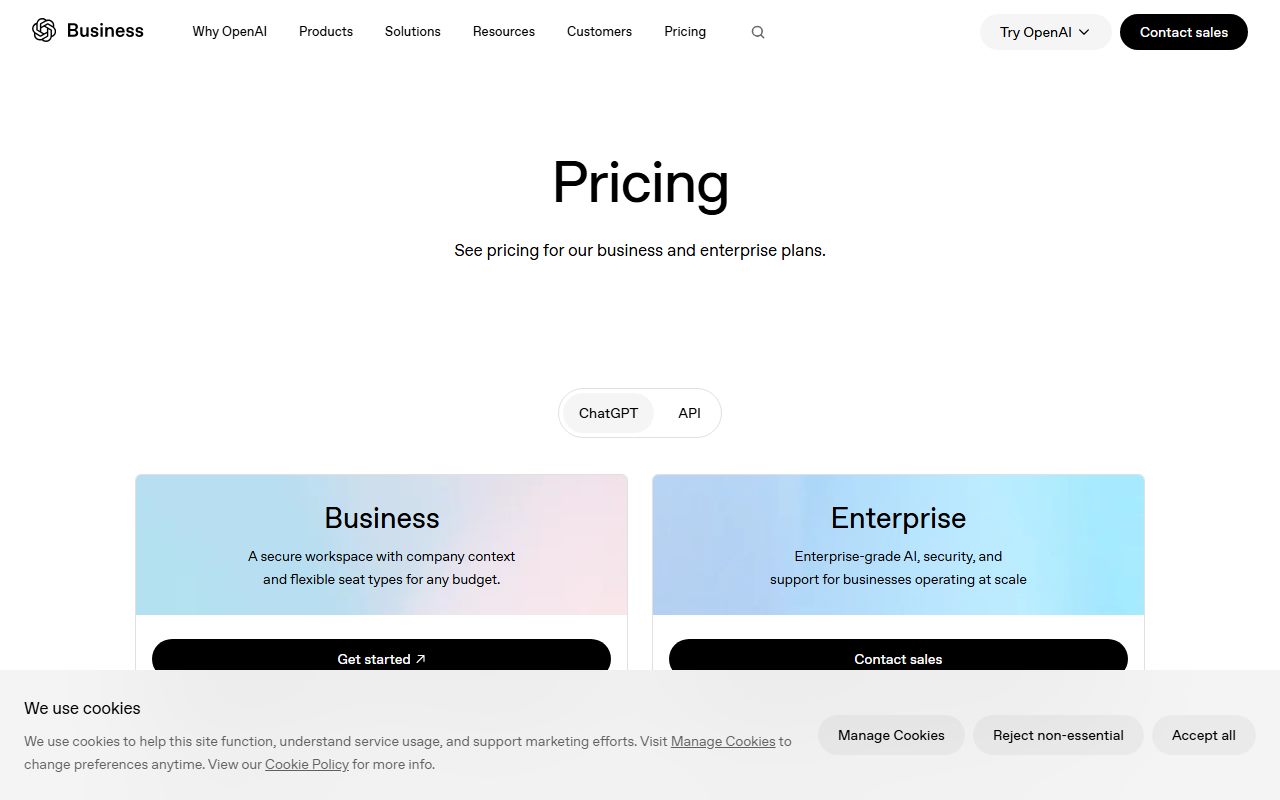
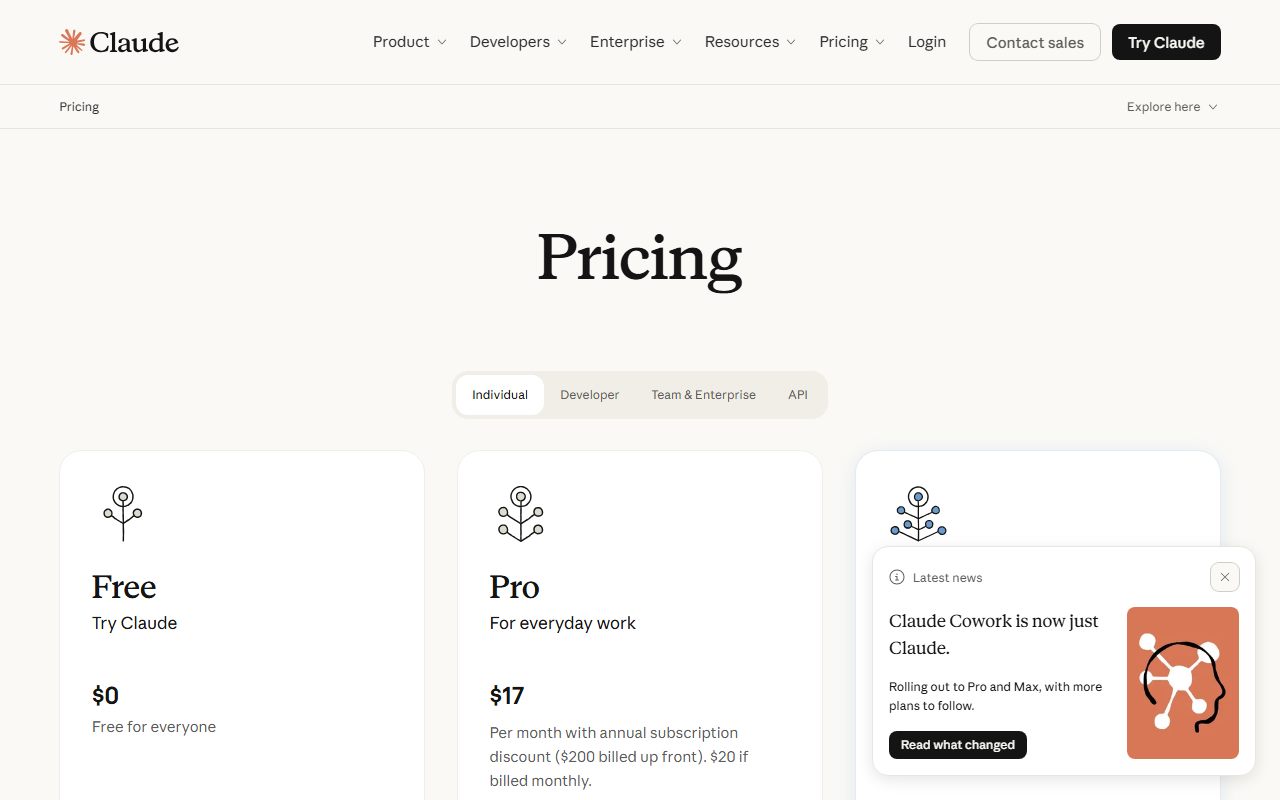
Both vendors list a standard seat at $20 a month billed annually and $25 billed monthly, and a premium seat at $100 billed annually and $125 billed monthly, per the pricing pages checked October 10, 2026. Both allow mixing seat types in one workspace.
For a ten-person team on standard seats, both come to $2,400 a year on annual billing or $250 a month on monthly billing. Eight standard and two premium seats, billed annually, come to $360 a month on either. That arithmetic is ours, from the vendors' listed prices.
The difference appears at the ceiling. ChatGPT Business is sold for teams of 2 to 200 employees. Claude Team is sold for teams of 2 to 150. A company of 160 has one option on the self-serve tier.
The second difference is what comes free with the seat. Claude Team lists up to $500 per month in pooled API credits. ChatGPT Business lists no equivalent. For a team that will never call an API, that is worth nothing; for one that runs a weekly script, it is a second product on the same bill.
Billing mechanics match on the self-serve tier: card payment, monthly or annual terms, no trial listed on either page. Invoicing is an Enterprise feature for both. Anthropic prices Enterprise at $20 a seat a month billed annually plus usage at API rates; OpenAI lists Enterprise as custom pricing with credit-based and token-based options.
A note on reading the pages: both localise prices. From a server in Vietnam, OpenAI's headline figures showed in dong with dollars underneath, and the dollar figures are what this comparison uses. For the per-token side of the market, see our Haiku 5.5 pricing note.
Features: ChatGPT Business publishes more; Claude Team bundles more
OpenAI's comparison table is the more detailed document. For Business it lists ChatGPT Work on desktop, web and mobile, Codex, projects and shared projects, scheduled tasks, Sites, a built-in browser, workspace agents, data analysis, record mode, deep research, image generation, and Excel, Word, PowerPoint and Google Sheets extensions. Connectors named are Google Workspace, Slack, GitHub and Microsoft 365.
It also publishes limits. The GPT Instant context window is 54K on Business and 128K on Enterprise, with an instant input maximum of about 40 pages against about 250. Reasoning context is 256K and about 320 pages on both. Memory with past chats is marked coming soon.
Anthropic's Team page lists Claude Code, the agent mode, projects with sharing, connectors, skills, memory, web search, Research, enterprise search, Design, Slides, Docs, Dashboards in beta, Claude Science, Claude in Chrome, and Claude for Microsoft 365 and Outlook. It publishes no context window or page limit for Team seats.
The practical split is this. If the team's output is spreadsheets, slides and documents inside Office or Google, ChatGPT Business names the extensions that put the assistant inside those files. If the team's output is code or long analysis, Claude Team puts the coding agent and the API on the standard seat.
One row on OpenAI's table deserves a flag. Dots, the always-on agent, reads Business Premium for the Business plan and Yes for Enterprise, which suggests it is tied to the premium seat. The page does not explain further. Claude's page marks Dashboards as beta and gives premium seats Fable at 50 percent of weekly limits.
Usage limits: neither vendor prints a number, and that matters more than any feature
This is the section a buyer should read twice, because it is where both pages go quiet.
OpenAI's table lists everyday text chats as unlimited subject to abuse guardrails, and every named model row as Flexible with a double asterisk whose footnote did not render in the copy we read. The premium seat's wording, no five-hour limit, implies a standard seat has one; the window's size is not stated.
Anthropic's page says usage resets on a rolling five-hour window, that weekly limits apply on paid plans, that Team seats get more usage than Pro, and that premium seats get five times a standard seat. No count is given.
Public reviews make this concrete. On Trustpilot, read October 10, 2026, the claude.ai profile's most frequent complaint is that limits arrive quickly, with one reviewer describing a single message in a small project consuming two percent of a weekly limit. The openai.com profile's complaints centre on support and billing rather than limits.
The honest conclusion: a manager cannot tell a new hire how many questions a day either seat allows. The premium seat exists on both plans precisely because the vendors know some users will hit the wall. Budget for one or two premium seats per ten people, on either plan, until your own usage shows otherwise.
Admin and security: equal on the self-serve tier, and both candid about what is missing
On Business, OpenAI lists SAML SSO, MFA, a dedicated workspace, unified billing, an admin console, bulk member management, admin roles, domain verification, SOC 2 Type 2, basic user analytics and an analytics dashboard. Not on Business: SCIM, Enterprise Key Management, granular GPT controls, role-based access, Compliance API logs, IP allowlisting, data residency in ten regions, Intune, a branded workspace, a global admin console, a connector registry and ISO 27001.
On Team, Anthropic lists SSO, domain verification, central billing, organisation-wide skills deployment, admin controls for remote and local connectors, enterprise deployment of the desktop app, usage analytics and organisation instructions. Not on Team: domain capture, role-based access, SCIM, audit logs, the Compliance API, custom data retention, network-level access control, IP allowlisting and HIPAA readiness.
Read side by side, the two lists are almost the same list. Both self-serve tiers give a company under 150 people SSO and an admin, and both hold back provisioning, audit and residency for Enterprise. Neither is the stronger buy on security alone.
Training policy is also a tie. OpenAI's table says content is used to train our models, No, for Business. Anthropic's says none by default for Team. The useful detail is on Anthropic's side: its individual Free, Pro and Max plans use an opt-out setting, which is one more reason a company should buy Team rather than reimburse Pro subscriptions.
Support: both poor in public, and only Enterprise buys a human
Neither self-serve tier lists priority support. OpenAI puts 24/7 priority support and SLAs under Enterprise. Anthropic's Team page lists no support tier at all; support is the help center and the in-app agent.
The public record is bad for both, with the same caveat. Trustpilot shows openai.com at 1.3 out of 5 from 1,238 reviews and claude.ai at 1.5 out of 5 from 2,042 reviews, as of October 10, 2026. Both profiles are unclaimed and neither company has invited reviews, so the samples are self-selected and mostly consumer.
The complaints differ in flavour. OpenAI's reviewers describe unanswered tickets, deactivated accounts and billing disputes. Anthropic's describe usage limits, a usage credits toggle that was on by default, and an AI support agent with no path to a person.
One independent counterweight exists for Claude: Gartner Peer Insights lists it at 4.6 out of 5 from 103 ratings. No equivalent page under the ChatGPT product name could be read at the address checked. G2 and Capterra returned access errors for both products on the day.
For a small team, the practical reading is that neither vendor sells a support experience on this tier, and the choice should be made on product, not on the hope of help.
What users report: enterprise reviewers rate the work, consumers rate the bill
The pattern across the sources read on October 10, 2026 is consistent for both products. Where reviewers chose the tool at work, scores are high: Claude's 4.6 on Gartner Peer Insights, and OpenAI's own Enterprise page quoting 83 percent weekly active users at a customer, which is vendor-selected and not treated here as independent evidence.
Where reviewers were surprised by a limit or a charge, scores are near the floor: 1.3 and 1.5 on Trustpilot. The reviews that mention a team plan by name are rare on both profiles.
No Business-specific or Team-specific review profile could be read this month. That is a gap in the evidence, and this comparison says so rather than filling it. The rule from our issue zero applies: primary sources, stated costs, and no inference where the vendor is silent.
Choose ChatGPT Business if, choose Claude Team if
The decision for most teams comes down to three questions: how many people, what kind of work, and whether anyone will use an API.
- Choose ChatGPT Business if your team is between 150 and 200 people, because Claude Team stops at 150
- Choose ChatGPT Business if your output is Office and Google documents and you want the Excel, Word, PowerPoint and Sheets extensions named on the table
- Choose ChatGPT Business if you want published context windows and page limits to plan around, which OpenAI's table gives and Anthropic's Team page does not
- Choose ChatGPT Business if your people already use ChatGPT personally and onboarding should be a login, not a change
- Choose Claude Team if your team includes developers who will use Claude Code or the pooled API credits of up to $500 a month
- Choose Claude Team if your work is contracts, research or transcripts, where shared projects and Research are the daily tools
- Choose Claude Team if you want the list of missing admin controls in writing on the plan page before you sign
- Choose Claude Team if you already run Claude in Chrome or inside Microsoft 365 and Outlook and want those under one admin
Where Microsoft 365 Copilot Business fits
A third plan belongs in the same conversation for one kind of company. Microsoft 365 Copilot Business is an add-on for existing Microsoft 365 Business customers, listed at $21 a user a month paid yearly with a promotional $18 through December 31, 2026, for up to 300 users, per Microsoft's pricing page checked October 10, 2026.
If your team already pays for Microsoft 365 and lives in Outlook and Teams, that add-on is cheaper than either plan here on promotion and drafts inside the files people already have open. If your team is not on Microsoft 365, the base-plan requirement makes it the most expensive of the three. The Microsoft 365 Copilot Business review works through that case, and all three are ranked in the best AI assistant plans for small teams.
Whichever plan you pick, the accountability question from our October 9 brief applies: decide who in the company answers for what the assistant produces before you assign seats.
Bottom line
At $20 a seat billed annually, ChatGPT Business and Claude Team are the same price and, on security and training policy, nearly the same product. ChatGPT Business takes the comparison for a general small office because it allows 200 seats, names its Office and Google extensions, and publishes its context limits, per the pricing pages checked October 10, 2026.
Claude Team takes it for a team with developers or long-document work, because Claude Code and up to $500 a month in pooled API credits ride on the standard seat. Neither vendor publishes a message quota, and both have weak public support records, so on either plan budget for a premium seat or two and do not expect a human on the other end of a ticket.
Frequently asked
Which is cheaper for a 10-person team, ChatGPT Business or Claude Team?
Neither. Both list a standard seat at $20 a month billed annually or $25 monthly, per the pricing pages checked October 10, 2026, so ten seats are $2,400 a year or $250 a month on either. Claude Team adds up to $500 a month in pooled API credits, which tips value its way only if you use them.
Can I switch from ChatGPT Business to Claude Team, or the other way?
Both are month-to-month on monthly billing, so a switch is a cancellation and a new signup; annual commitments run to term. Neither page describes an import tool for chat history or projects as of October 2026, so plan to re-create shared projects by hand.
Which plan has the higher seat limit?
ChatGPT Business, at 2 to 200 employees per OpenAI's business pricing page. Claude Team is sold for teams of 2 to 150 per Anthropic's page, both checked October 10, 2026. Above those ceilings, each vendor points to its Enterprise plan.
Do either of them train on company data?
Not by default. OpenAI's comparison table marks content used to train our models as No for Business; Anthropic's table marks model training as None by default for Team. Anthropic's individual plans use an opt-out instead, which is a reason to buy the team plan rather than reimburse Pro seats.
Which plan is better for developers?
Claude Team, on the documentation: Claude Code is on every seat and up to $500 a month in pooled API credits is included, per the Team page checked October 10, 2026. ChatGPT Business includes Codex but lists no API credits. A team that already pays for API access separately may weigh this differently.
Visit ChatGPT Business
We have no affiliate relationship with this vendor. Link goes to the official site.
Visit Claude Team
We have no affiliate relationship with this vendor. Link goes to the official site.