 AI

Claude Team
Claude's team plan: $20 a seat billed annually for 2 to 150 people, premium seats at five times the usage, and up to $500 a month in pooled API credits.
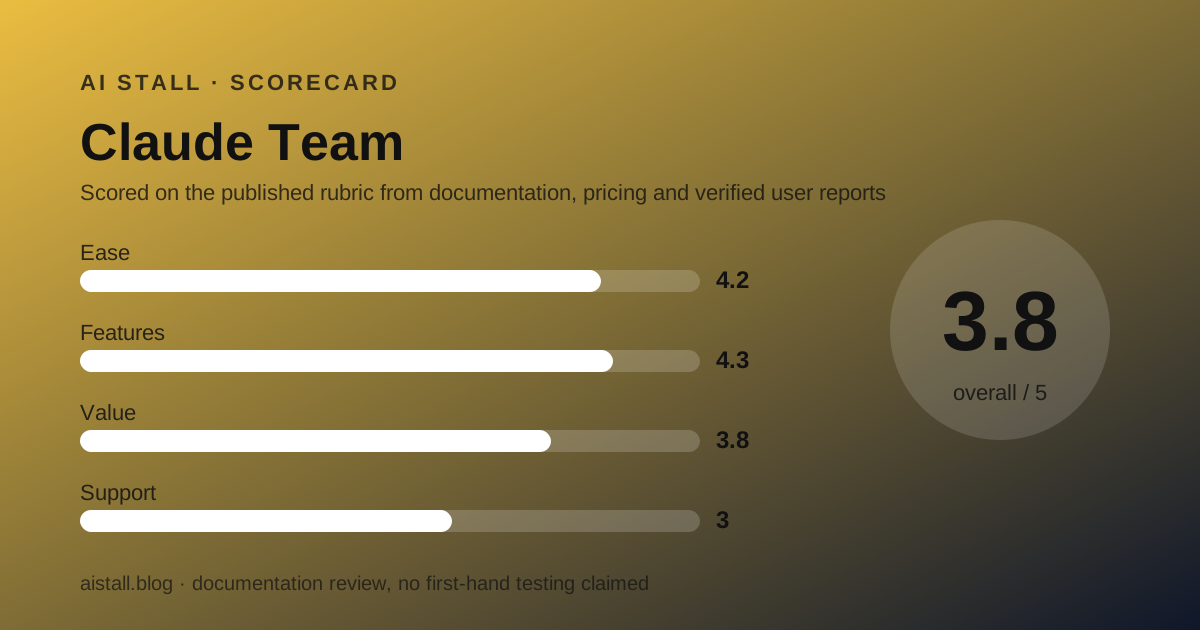
Scored on the published rubric, from documentation, pricing and verified user reports.
Best for: Teams of 2 to 150 that work in long documents or code, want Claude Code and shared projects under one admin, and can use the pooled API credits to run small automations without a separate developer account.
Verdict
This is a documentation review built from the Claude pricing page, the Team plan page and public user reports, all checked October 10, 2026; no workspace was created for this page. Claude Team prices a standard seat at $20 a month billed annually or $25 monthly, with a premium seat at $100 or $125 offering five times the usage, and the two can be mixed across a workspace of 2 to 150 people. Three things set it apart from the ChatGPT equivalent at the same price: up to $500 a month in pooled API credits, Claude Code included on every seat, and a Team page that lists exactly which admin controls are missing (SCIM, audit logs, role-based access, custom retention) rather than leaving the buyer to infer them. Content is not used for training by default. The weaknesses are documented too. Usage is governed by a rolling five-hour window plus weekly limits, and the page gives no message count; public reviews are dominated by complaints that limits arrive quickly and that support is an AI agent with no path to a person. Payment is card only, with no invoicing on Team. For a team with developers or heavy document work, it is the stronger plan; for a general office team, the lower-friction choice is ChatGPT Business.
Visit Claude Team
We have no affiliate relationship with this vendor. Link goes to the official site.
Where it is strong
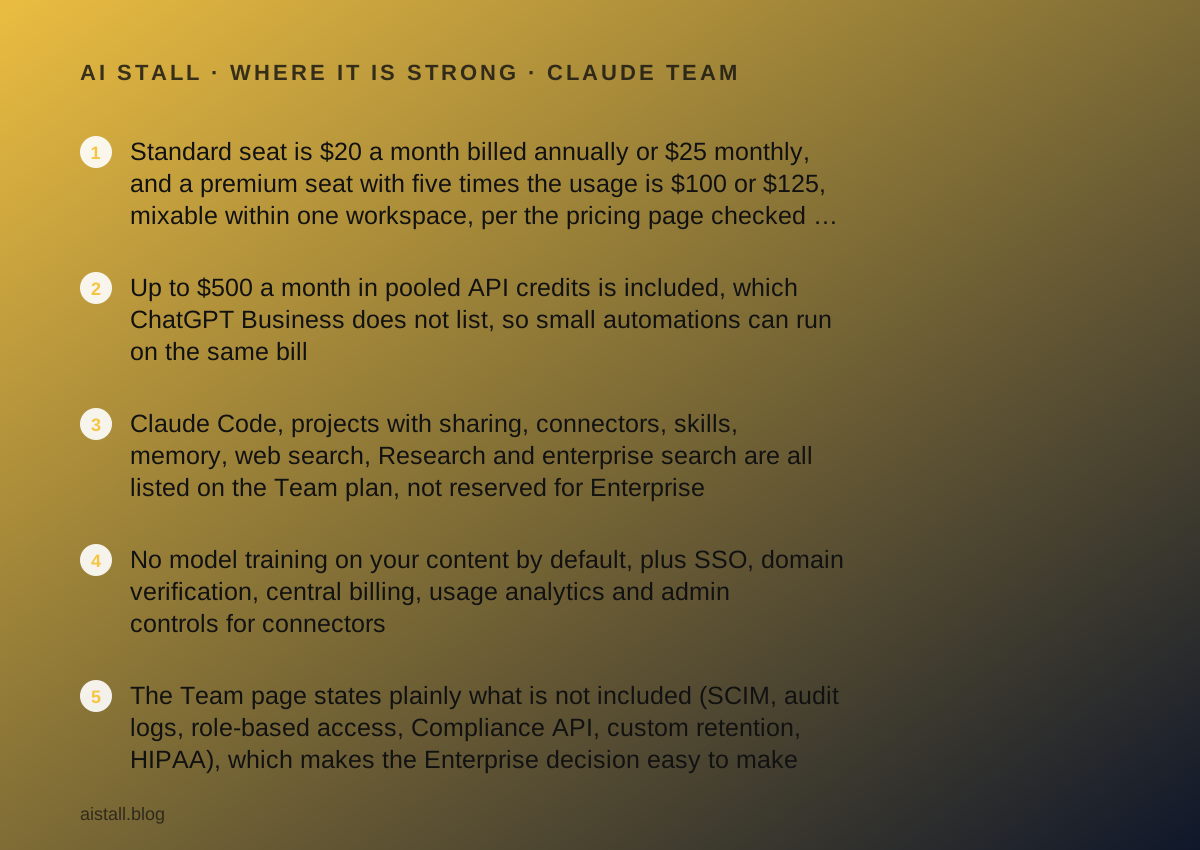
- Standard seat is $20 a month billed annually or $25 monthly, and a premium seat with five times the usage is $100 or $125, mixable within one workspace, per the pricing page checked October 10, 2026
- Up to $500 a month in pooled API credits is included, which ChatGPT Business does not list, so small automations can run on the same bill
- Claude Code, projects with sharing, connectors, skills, memory, web search, Research and enterprise search are all listed on the Team plan, not reserved for Enterprise
- No model training on your content by default, plus SSO, domain verification, central billing, usage analytics and admin controls for connectors
- The Team page states plainly what is not included (SCIM, audit logs, role-based access, Compliance API, custom retention, HIPAA), which makes the Enterprise decision easy to make
Where it falls short
- The vendor publishes no message count: usage resets on a rolling five-hour window with weekly limits on paid plans, and the Team seat is described only as more usage than Pro
- Public reports are poor: Trustpilot shows 1.5 out of 5 from 2,042 reviews for claude.ai as of October 10, 2026, with usage limits and AI-only support the most common complaints, though the profile is unclaimed
- Payment is credit card only on Team; ACH and invoicing with net terms are listed only for Enterprise
- No trial is listed for Team; the Trials row appears only under sales-assisted Enterprise
- The seat ceiling is 150, below the 200 on ChatGPT Business and the 300 on Microsoft 365 Copilot Business
At a glance
| Starting price | $20/seat/mo billed annually, $25 monthly |
|---|---|
| Pricing note | From $20/seat/mo billed annually, $25 monthly (pricing page, Oct 2026) |
| Premium seat | $100/seat/mo annually, $125 monthly, 5x usage |
| Seat range | 2 to 150 |
| Free plan | Individual Free plan with 5 projects; no free team tier |
| Trial | Not listed for Team |
| Data training | None by default |
| API credits | Up to $500/mo pooled |
| Support channels | Help center and in-app agent; priority support not listed for Team |
What Claude Team actually is
Claude Team is the seat-based workspace tier of Claude. It sits between the individual Pro and Max plans and the Enterprise plan, and the pricing page checked October 10, 2026 describes it as for teams of 2 to 150.
The structure mirrors its main rival. A standard seat includes all Claude features plus more usage than Pro. A premium seat offers five times more usage than a standard seat. The two can be mixed, so a workspace can hold twelve standard seats and two premium ones.
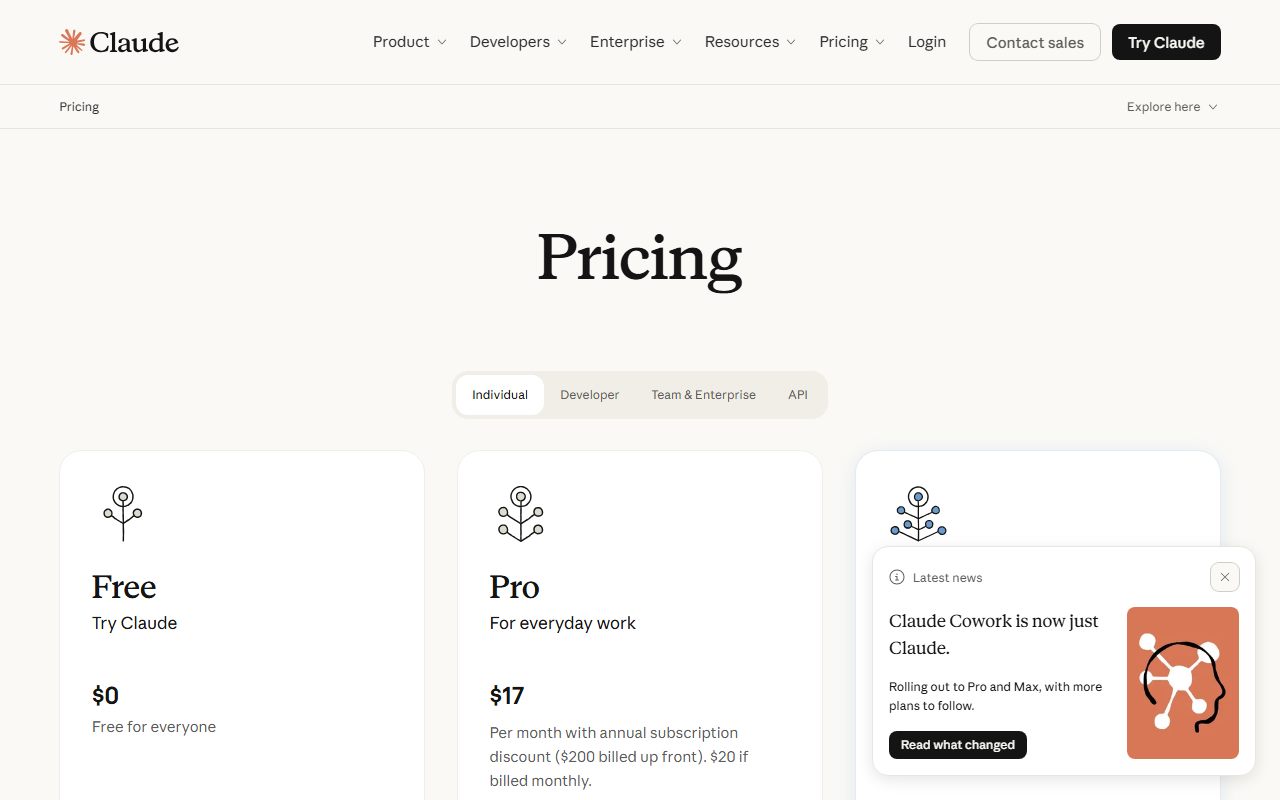
One banner on the page is worth recording: Claude Cowork is now just Claude. The agent mode that used to carry a separate name is folded into the product, and the Team page lists it alongside Claude Code as included.
The pooled API credits are the structural difference from ChatGPT Business. The page lists up to $500 per month in pooled API credits on Team, which means a workspace can call the API for scripts and integrations without opening a separate developer account.
Who Claude Team is best for
The documentation points at a particular kind of small team.
- A team of 2 to 150 with at least one developer who will use Claude Code or the pooled API credits
- A firm whose core work is long text: contracts, policies, research, transcripts, where shared projects and Research are the daily tools
- A founder who wants the list of missing admin controls in writing before signing, which the Team page provides
- A team that already runs Claude in Chrome or inside Microsoft 365 and Outlook and wants those under one admin
- A team of under 150 that is fine paying by card on monthly or annual billing
- Who should skip it: a company that needs invoicing, SCIM, audit logs or role-based access, all Enterprise-only per the page
- Who should skip it: a Microsoft 365 Business shop that lives in Office apps, where the Copilot Business add-on is priced lower on promotion
What a standard seat includes, as of October 2026
The Team page lists the included features in a long block. Claude Code and the agent mode. Projects with sharing and collaboration. Connectors, skills, memory, web search and Research. Enterprise search across the organisation. Claude Design, Slides, Docs, Dashboards in beta, and Claude Science. Claude in Chrome and Claude for Microsoft 365 and Outlook.
On the admin side, Team includes central billing and administration, SSO, domain verification, organisation-wide skills deployment, admin controls for remote and local connectors, enterprise deployment of the desktop app, usage analytics and organisation instructions.
The page then lists what Team does not include: domain capture, role-based access, SCIM, audit logs, the Compliance API, custom data retention controls and the HIPAA-ready offering. All of those are on Enterprise.
For comparison, the individual Free plan includes chat on web, desktop and mobile, web search, file creation, code execution, memory, connections, Artifacts, and the Design, Slides and Docs tools, but caps projects at five and excludes Opus and Claude Code. Pro, at $20 a month or $17 on annual billing, adds those.
Model access on Team is described only indirectly. Premium seats get Fable at 50 percent of weekly limits, per the page. Standard seats are not given a model-by-model table, and this review does not infer one.
How the pricing is structured
Standard seat: $20 a month billed annually, $25 billed monthly. Premium seat: $100 a month billed annually, $125 billed monthly. Both per seat, per the pricing page checked October 10, 2026.
A ten-person team on standard seats pays $2,400 a year on annual billing or $250 a month on monthly billing. Eight standard and two premium seats, billed annually, come to $360 a month. Those totals are the editors' arithmetic from the listed prices.
The seat range is 2 to 150. Seats can be added mid-term. Payment is by credit card; ACH and invoicing are not available on Team, per the comparison table. There is no trial row for Team.
Enterprise is priced at $20 a seat a month billed annually plus usage at API rates, with the page noting that usage cost scales with model and task. Sales-assisted Enterprise adds invoicing and net terms; self-serve Enterprise supports ACH.
The API rates matter because of the pooled credits. Per the same page, Haiku 5.5 is $0.10 per million input tokens and $0.50 per million output for prompts up to 100K tokens; Sonnet 5.5 is $2 and $10; Opus 5.5 is $4 and $20; Fable 5.1 is $10 and $50. Our October 10 note on Haiku 5.5 pricing explains what that buys.
Ease of use: what the 4.2 is built from
The score comes from documented surfaces, not a walkthrough. Claude runs on web, desktop and mobile, inside Chrome, and inside Microsoft 365 and Outlook, all listed on the Team page. A team member who used the Free plan sees the same product with more usage.
The admin set is adequate for a company under 150 people: SSO, domain verification, central billing, usage analytics, connector controls, organisation instructions and desktop deployment.
The deductions are for the usage model. Limits reset on a rolling five-hour window with weekly limits on paid plans, and the page gives no number. A manager cannot tell a new hire how many questions a day the seat allows, and public reviews suggest people find out the hard way.
Features: what the 4.3 is built from
On breadth, Team is close to Enterprise. Claude Code, the agent mode, shared projects, connectors, skills, memory, web search, Research, enterprise search, Design, Slides, Docs, Dashboards in beta and Claude Science are all included, per the Team page.
Two items earn the plan its score against ChatGPT Business. The pooled API credits, up to $500 a month, let a small team run automations without a second account. And Claude Code on every seat means the developers and the rest of the company share one bill.
The points withheld are for the features marked beta or restricted. Dashboards is beta. Fable access on premium seats is limited to 50 percent of weekly limits. Standard-seat model access is not tabulated.
Value: what the 3.8 is built from
At $20 a seat billed annually, Team matches ChatGPT Business and the individual Pro monthly price, per the respective pricing pages checked October 10, 2026. The $500 of pooled API credits is a real addition at that price, if a team uses it.
The score is held back by three documented facts. The seat ceiling is 150, against 200 and 300 for the two rivals in our small-team ranking. There is no trial. And the usage limits that public reviewers complain about are not quantified, so the effective price per useful hour cannot be estimated from the page.
If a team will not use Claude Code or the API credits, the value case against ChatGPT Business at the same price is thin; the side-by-side comparison works through that case.
Support: what the 3.0 is built from
The Team page lists no priority support, SLA or named contact; those live on Enterprise. Support is the help center and the in-app agent.
Public reports are the reason for the low score. Trustpilot's claude.ai page, read October 10, 2026, shows 1.5 out of 5 from 2,042 reviews, 80 percent at one star. Trustpilot flags the profile as unclaimed and the sample as possibly unrepresentative.
The recurring complaints in those reviews are usage limits reached too quickly, a usage credits toggle described as on by default that led to unexpected charges, support handled by an AI agent with no route to a person, and account access problems. None of this is Team-specific, and none is verifiable from outside, but it is the public record a buyer will find.
What verified users report
Two sources could be read on October 10, 2026. Gartner Peer Insights lists Claude at 4.6 out of 5 from 103 ratings, with headline reviews from a business analyst and a product manager that mention efficient integration and manual review requirements. Trustpilot gives the 1.5 described above.
The gap between a 4.6 from enterprise reviewers and a 1.5 from self-selected consumers is the usual pattern for this category: people who chose the tool at work rate the work; people who were surprised by a bill rate the bill.
G2 and Capterra returned access errors on the day. No Team-specific review profile exists that this review could read, so the grades rest on the vendor's documentation plus the two profiles above.
Limits stated by the vendor, privacy and data use
Training: none by default on Team and Enterprise, per the comparison table. Free, Pro and Max use an opt-out setting. That distinction is the single best reason for a small company to buy Team rather than reimburse Pro subscriptions.
Usage: a rolling five-hour window on all plans, weekly limits on paid plans, extra usage and priority access at high-traffic times on Team, Fable at 50 percent of weekly limits on premium seats. No message counts are published.
Security and compliance on Team: SSO, domain verification, connector admin controls, usage analytics. Not on Team: SCIM, audit logs, role-based access, the Compliance API, custom data retention, network-level access control, IP allowlisting, HIPAA readiness. The page lists Claude Security as beta on Enterprise.
One policy note. Anthropic's 2026 usage policy update, covered in our October 9 brief, requires a qualified human reviewer for uses that affect someone's health, finances, legal rights or livelihood. A team buying seats for lending, hiring or clinical work should read that section before rolling out.
Alternatives
ChatGPT Business. The same $20 standard and $100 premium seat prices billed annually, per OpenAI's business pricing page checked October 10, 2026, with 2 to 200 seats, connectors to Google Workspace, Slack, GitHub and Microsoft 365, Codex and a no-training default.
Choose ChatGPT Business if your team is a general office without developers and wants the Office and Google Sheets extensions. Otherwise choose Claude Team for Claude Code and the pooled API credits. Full reasoning in ChatGPT Business vs Claude Team.
Microsoft 365 Copilot Business. An add-on for existing Microsoft 365 Business customers, $21 a user a month paid yearly with a promotional $18 through December 31, 2026, up to 300 users, per Microsoft's pricing page. Choose it if your team already pays for Microsoft 365 and works in Word, Excel, Outlook and Teams. Otherwise choose Claude Team, which needs no base subscription. See the Microsoft 365 Copilot Business review.
The three are ranked, with the reasoning, in the best AI assistant plans for small teams.
Buy it if, skip it if
Buy it if your team has developers who will use Claude Code or the API credits. Buy it if your work is long text and shared projects. Buy it if you want the missing admin controls listed in writing. Buy it if you are under 150 people and can pay by card.
Skip it if you need invoicing, SCIM, audit logs or role-based access. Skip it if you are a Microsoft 365 Business shop living in Office apps. Skip it if you need a published daily quota to plan around.
As our issue zero puts it, the rule is primary sources and stated costs; where the vendor does not publish a number, this review says so.
Bottom line
Claude Team is the better of the two $20 team plans for a company that writes code or works in long documents, because Claude Code and up to $500 a month in pooled API credits come on the standard seat, per the pricing page checked October 10, 2026. It is also the more candid plan page in the category about what is missing.
It is the weaker choice for a general office team that will not touch the API, because the seat ceiling is lower, there is no trial, and the usage limits that dominate public complaints are not quantified. If that describes your team, start with the ChatGPT Business review instead.
Buy it if
- Your team includes developers who will use Claude Code or the pooled API credits, because both are on the standard seat
- Your work is long documents, contracts, transcripts or research, where shared projects and Research matter more than slide decks
- You want a vendor whose Team page lists the missing admin controls in writing before you buy
- You are between 2 and 150 people and can pay by card on monthly or annual billing
Skip it if
- You need invoicing, SCIM, audit logs or role-based access, all of which the page reserves for Enterprise
- Your team already runs on Microsoft 365 Business and works inside Office apps, where Microsoft 365 Copilot Business is the lower-friction add-on
- You need a published daily message quota to plan around, which the vendor does not give
Frequently asked
How much does Claude Team cost for a 10-person team?
Per the pricing page checked October 10, 2026, a standard seat is $20 a month billed annually, so ten seats are $2,400 a year, or $250 a month on monthly billing at $25 a seat. That is our arithmetic from the listed prices; the vendor does not print a team total.
What is the minimum number of seats on Claude Team?
The pricing page describes Team as for teams of 2 to 150, so two seats is the floor and 150 the ceiling as of October 2026. Seats can be added mid-term, and standard and premium seat types can be mixed in one workspace.
Does Claude Team train on our data?
No, by default. The pricing page says no model training on your content by default for Team, and the comparison table lists model training as None by default. The individual Free, Pro and Max plans use an opt-out setting instead, per the same page.
Is Claude Code included in Claude Team?
Yes. The Team plan page lists Claude Code among included features, along with projects, connectors, skills, Research, Claude in Chrome and Claude for Microsoft 365 and Outlook, as of October 10, 2026. The individual Free plan does not include Claude Code.
What are the $500 pooled API credits for?
The pricing page lists up to $500 per month in pooled API credits on Team. At the published Haiku 5.5 rate of $0.10 per million input tokens, that budget covers a large volume of small automated jobs; the page does not say whether unused credits roll over.
Does Claude Team have a free trial?
The pricing page lists no trial for Team as of October 10, 2026; the Trials row appears only under sales-assisted Enterprise. The individual Free plan is the way to try the assistant, with five projects and the Sonnet and Haiku models but no Claude Code.
Sources
- Claude pricing page - checked October 10, 2026
- Claude Team plan page - checked October 10, 2026
- Trustpilot profile for claude.ai - checked October 10, 2026
- Gartner Peer Insights, Claude - checked October 10, 2026
Update history
- October 10, 2026 - First published from the Claude pricing and Team pages checked October 10, 2026.
Visit Claude Team
We have no affiliate relationship with this vendor. Link goes to the official site.