 AI

GitHub Copilot Business
A $19 per seat coding assistant whose AI usage is paid in credits worth one cent each, pooled across the organisation and capped by an admin.
Scored on the published rubric, from documentation, pricing and verified user reports.
Best for: Small engineering teams that already live on GitHub and want one predictable seat price, unlimited code completion, and an admin who can cap AI spending before it becomes a surprise.
Verdict
This is a documentation review built from the GitHub Copilot plans page, three GitHub Docs articles on plans, seats and billing cycles, and the public Trustpilot profile, all checked October 22, 2026. No organisation was created for this page.
Copilot Business is $19 USD per granted seat per month and Copilot Enterprise is $39, figures that appear identically on the marketing page and in the docs.
The pricing model is the part worth understanding. GitHub now meters AI usage in GitHub AI Credits, and the plans page states plainly that 1 AI credit equals $0.01 USD. Business includes 1,900 credits per user per month, Enterprise 3,900.
Code completions and next edit suggestions are explicitly not billed in credits and stay unlimited on every paid plan. So the seat price buys unlimited autocomplete plus a fixed allowance of agent and chat work.
Credits are pooled. The docs say each licence contributes credits to a shared enterprise pool, and the plans page lists pooled usage as a Business and Enterprise feature that individual plans do not get.
Two things keep the score off the top. The individual plans publish a flex allotment on top of base credits, so Pro at $10 carries 1,500 total credits, while the organisational rows publish a total only, equal to the dollar price.
And removing a user does not stop the bill. GitHub states that suspended or removed users lose access immediately but their seats are still billed through the end of the cycle. Neither page published a Business trial on the day we read them.
Visit GitHub Copilot Business
We have no affiliate relationship with this vendor. Link goes to the official site.
Where it is strong
- One readable number per seat, stated the same way on two separate vendor pages: $19 USD per granted seat per month on the plans page and $19 USD per granted seat per month in GitHub Docs, both checked October 22, 2026
- Code completion is not metered: the plans page states that code completions and next edit suggestions do not use credits and remain unlimited with every paid plan
- Credits are pooled across the organisation. The docs state each licence contributes AI credits to a shared enterprise pool, and the plans page lists pooled usage as unavailable on Free, Pro, Pro+ and Max
- The spending cap is a real control, not a warning. The plans page states that on Business and Enterprise, admins set usage limits and decide whether additional paid usage is allowed, and if it is not, Copilot pauses until the next cycle
- Business includes IP indemnity and data privacy, access control, budget control and governance, and access to a broad model catalogue, per the plan card on the plans page checked October 22, 2026
Where it falls short
- A $19 Business seat includes 1,900 credits, which is $19 of credit at the published rate of $0.01 each; a $10 Pro plan includes 1,500 credits, or $15. The individual plans publish a flex allotment on top of base credits and the Business row does not
- Removing a person does not stop the charge: GitHub Docs state that users suspended or removed lose access to Copilot immediately, but their seats are still billed through the end of the current billing cycle
- No free trial for Copilot Business appeared on either the plans page or the GitHub Docs plans page on October 22, 2026, and no annual price or seat minimum was published on either
- Support on the Business card is listed only as web-based support, with a footnote stating that response times may vary during periods of high usage and requests may be subject to rate limiting
- Trustpilot shows github.com at 1.8 out of 5 from 282 reviews as of October 22, 2026, with 53 percent at one star, on an unclaimed profile; the sample is small and covers GitHub as a whole, not Copilot
At a glance
| Business price | $19 USD per granted seat per month |
|---|---|
| Pricing note | $19 USD per granted seat per month, 1,900 AI credits per user (plans page and docs, Oct 2026) |
| Enterprise price | $39 USD per granted seat per month |
| Credits, Business | 1,900 per user per month |
| Credits, Enterprise | 3,900 per user per month |
| Credit rate | 1 AI credit = $0.01 USD |
| Code completion | Not billed in credits, unlimited on paid plans |
| Pooled credits | Business and Enterprise only |
| Budget alerts | 75%, 90% and 100% of a configured budget |
| Enterprise Server | Copilot not currently available |
What GitHub Copilot Business actually is
Copilot Business is the organisational licence for GitHub's coding assistant, sold per seat with centralised policy control. The docs describe it as made for organisations and enterprises, offering centralised management and Copilot policy control for organisation members.
What a seat buys has changed shape in 2026. It is no longer one subscription that covers everything the assistant does.
Instead there are two layers. Unlimited code completion and next edit suggestions, which the seat covers outright.
Then an allowance of GitHub AI Credits, which pays for the parts that call a model on your behalf: chat, agent mode, code review, the cloud agent and the CLI.
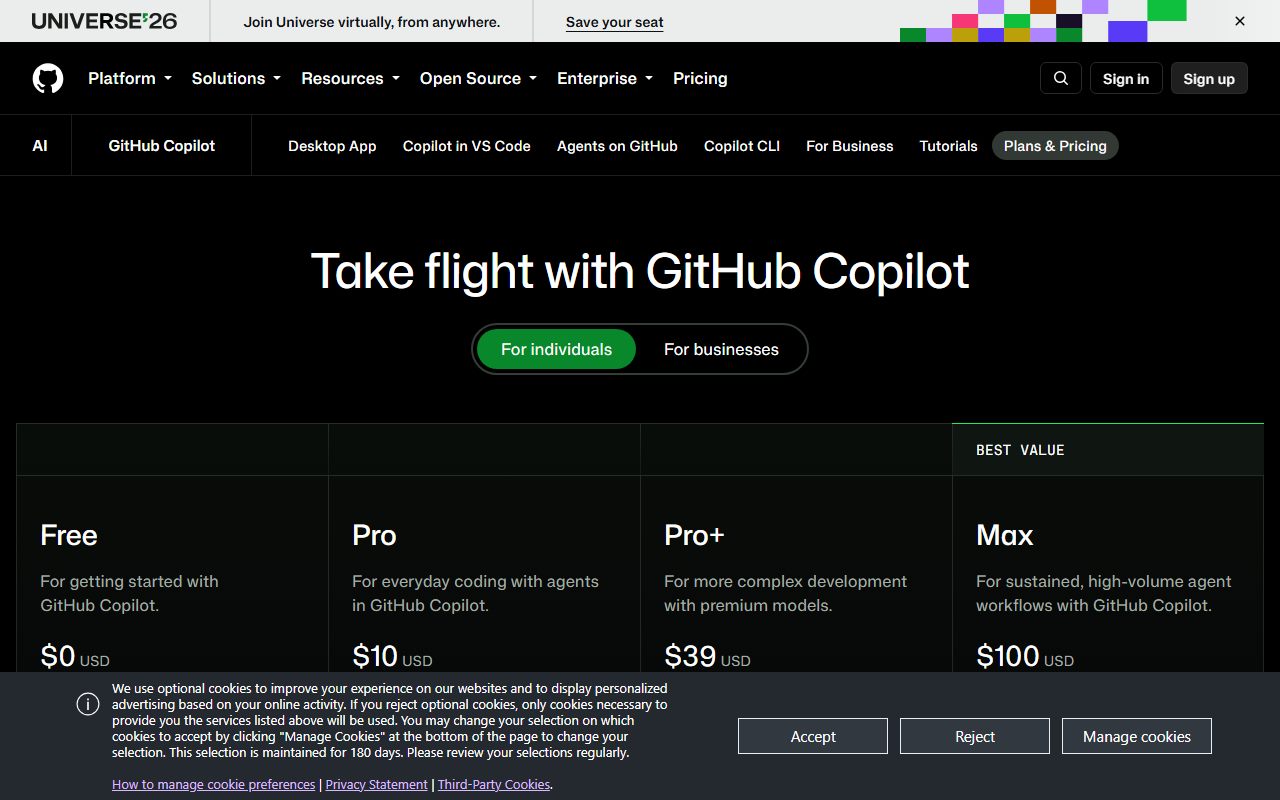
The plans page states the exchange rate in one sentence: every plan includes a monthly allowance, and 1 AI credit equals $0.01 USD.
That single line is the most useful thing on the page, because it turns every credit figure into dollars without arithmetic.
Who Copilot Business is best for
The documentation points at teams whose code already lives on GitHub and whose finance person wants a ceiling.
- A three to fifteen person engineering team with repositories, issues and reviews already on GitHub.com
- A team that writes a lot and prompts a little, since autocomplete is unmetered and only agent work draws credits
- An owner who wants one admin screen to set a spending limit and have the tool stop rather than keep billing
- A consultancy that needs IP indemnity stated in the plan rather than requested from sales
- A team that wants several model families behind one invoice instead of several vendor accounts
- Who should skip it: a team that needs to pilot before paying, because no Business trial was published on October 22, 2026
- Who should skip it: a team on GitHub Enterprise Server, which the docs say Copilot does not currently support
How AI credits work, as of October 2026
Credits replaced the older request counting, and the mechanics are published clearly enough to plan against.
Per the plans page checked October 22, 2026, credits are consumed when you chat with Copilot and work with agents. How many a single interaction uses depends on the model and the complexity of the task.
The page is honest about the range. A quick question to a lightweight model costs a fraction of a credit. A longer agent session on a frontier model across many files costs more.
What is not metered matters as much. Code completions and next edit suggestions do not use credits and remain unlimited with every paid plan.
For organisations the docs add the pooling rule: each licence contributes AI credits to a shared enterprise pool, and usage beyond the pool is charged at $0.01 USD per AI credit.
Pooling is a Business and Enterprise feature. The plans page comparison lists pooled usage as not included on Free, Pro, Pro+ and Max.
A $19 seat carries less credit than a $10 personal plan
This is the oddest thing on the published tables, and it is worth setting out with both sources.
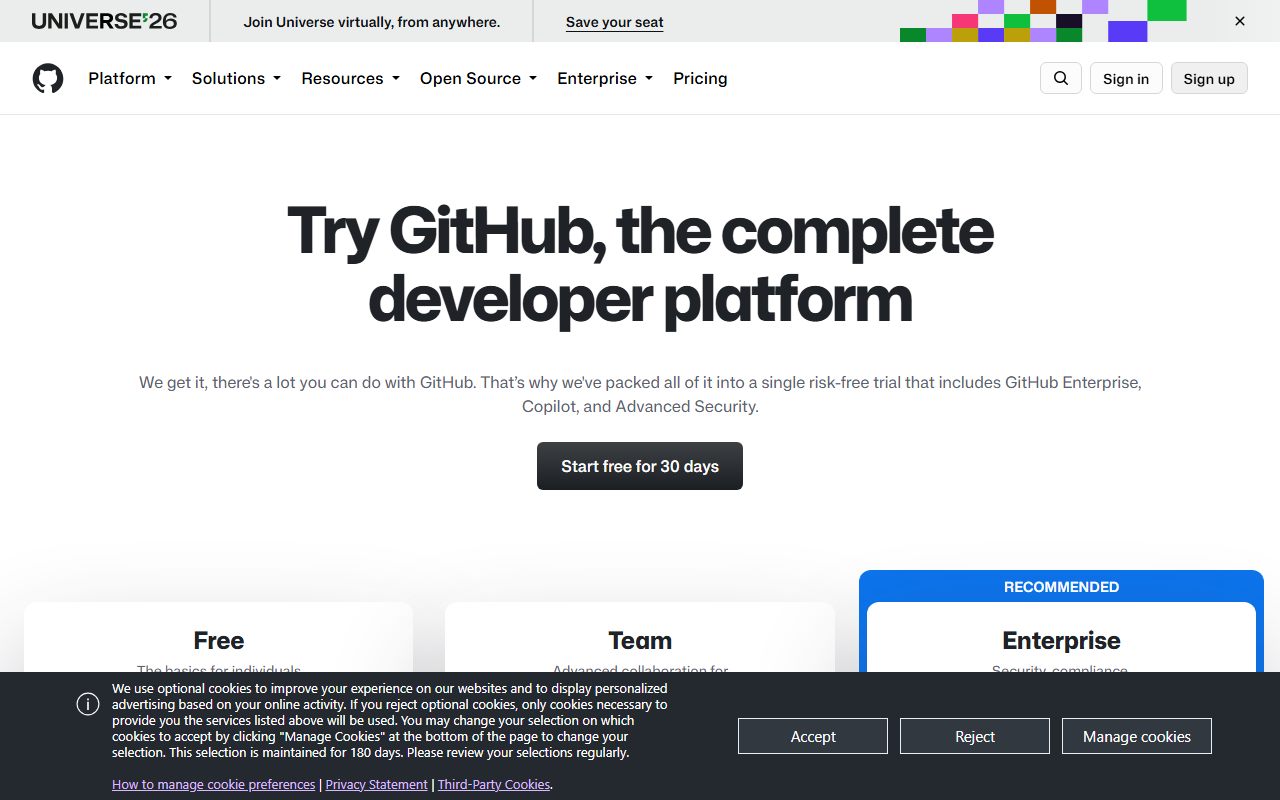
The GitHub Docs plans article, read October 22, 2026, gives the individual allowances as three columns: base credits, flex allotment, and total.
Pro is 1,000 base plus 500 flex for 1,500 total. Pro+ is 3,900 plus 3,100 for 7,000. Max is 10,000 plus 10,000 for 20,000.
The organisation table has no flex column. Copilot Business is listed as a total of 1,900 credits per user per month, and Copilot Enterprise as 3,900.
Converted at the published cent per credit, that is the editors' arithmetic: a $10 Pro plan carries $15 of credit, a $39 Pro+ carries $70, a $100 Max carries $200. A $19 Business seat carries $19.
So the paid individual plans are sold at a discount to their credit value and the organisational seats are sold at par.
What the organisational seats buy instead is the pool, the policy controls, the budget ceiling and the indemnity. Whether that trade is worth it depends on how unevenly your team prompts, which is the whole point of pooling.
The plans page also footnotes that flex allotments may change over time, so this gap is a reading of one day rather than a permanent rule.
What the pooled pool changes for a five-person team
Pooling is the feature that makes a per-seat price work on a small team with uneven habits.
Five Business seats is $95 a month and 9,500 credits, which is the editors' multiplication from the published figures. Those credits sit in one pool rather than five buckets of 1,900.
That matters because agent usage is never evenly spread. One person refactoring a legacy service can burn several times a colleague's allowance in the same week without anyone hitting a wall.
On the individual plans that same team would hold five separate allowances with no sharing, since the comparison table lists pooled usage as not included on Pro, Pro+ and Max.
The ceiling is set by the admin, not by the vendor. The plans page states that on Business and Enterprise, admins set usage limits and decide whether additional paid usage is allowed.
If it is not allowed, Copilot pauses until the next cycle. Alerts fire at 75, 90 and 100 percent of any configured budget. A small team should set that budget on day one, because the alternative is finding out in arrears.
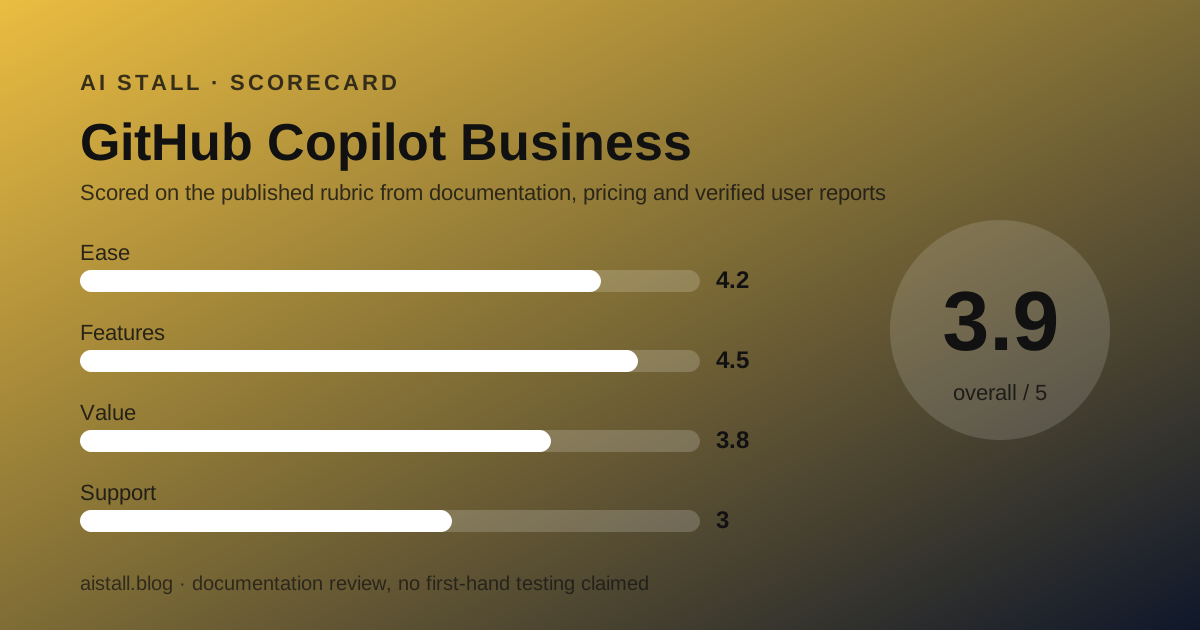
Ease of use: what the 4.2 is built from
This is the highest ease score we have given a per-seat AI product, and it is earned mostly on price legibility.
Two separate vendor pages state the same two numbers. $19 USD per granted seat per month for Business and $39 for Enterprise appear on the marketing plans page and in the GitHub Docs plans article, both read October 22, 2026.
That sounds like a low bar. It is not. Contradictions between a vendor's marketing page and its own help centre are common enough that we check for them first.
Billing behaviour is also published rather than discovered. Adding seats is billed pro rata for the rest of the cycle, included credits for those seats may also be prorated, and card or PayPal payers pay the prorated amount upfront.
The deduction is the other half of that rule. Removing seats does not stop the charge until the cycle ends, and a suspended or removed user loses access immediately while the seat keeps billing.
The second deduction is the missing trial. For a product sold to teams, no published trial length on either page is a real gap.
Features: what the 4.5 is built from
Breadth is the strongest column here, and it rests on what the Business card and the docs tables actually list rather than on claims about quality.
The Business plan card lists unlimited code completion and next edit suggestions, access to the cloud agent and code review, 1,900 credits per user, and access to third-party agents.
It also lists access to a broad model catalogue, web-based support, IP indemnity and data privacy, and access control, budget control and governance.
The docs add the surfaces: Copilot CLI and the Copilot app are included in all plans, alongside chat in IDEs, inline chat, slash commands, chat in GitHub Mobile and chat in Windows Terminal.
The model catalogue listed for Business and Enterprise spans Anthropic, OpenAI, Google, xAI, Microsoft and Moonshot families, which is wider than any single-vendor assistant can offer.
Two footnotes temper the list. Code review will incur Actions usage, so it is not free of other meters. And response times may vary during periods of high usage.
For how this agent-on-its-own-meter pattern spread across the industry, see our note on who pays when the agent does the work.
Value: what the 3.8 is built from
Value is the column the credit arithmetic pulls down, and the unmetered autocomplete pulls back up.
Start with what is free at the seat price: unlimited code completion and next edit suggestions, on every paid plan, with no credit draw.
For a team whose main daily use is autocomplete in the editor, that is most of the product for a fixed $19.
Then the metered half. 1,900 credits is $19 of model work per person per month at the published rate. A team doing heavy agent work will pass that, and overage runs at the same cent per credit.
Against the individual plans the seat looks expensive per credit, as set out above. Against hiring, it does not.
For how the same vendors price general office work, see the best AI assistant plans for small teams.
The score lands at 3.8 because the unmetered half is generous and the metered half is priced at face value, with no trial to test your real consumption first.
Support: what the 3.0 is built from
Support is the weakest column and the thinnest documented.
The Business plan card lists support as web-based support. No response time target, no service level commitment and no named contact appear for Business on the plans page read October 22, 2026.
The nearest thing to a commitment is a footnote in the other direction: response times may vary during periods of high usage, and requests may be subject to rate limiting.
Enterprise adds priority access to new models and features, which is a product benefit rather than a support benefit.
The public record is poor but blunt about its own limits. Trustpilot shows github.com at 1.8 out of 5 from 282 reviews as of October 22, 2026, with 53 percent at one star and 36 percent at five, on an unclaimed profile.
That profile covers GitHub as a whole rather than Copilot, and 282 reviews is far too small a sample for a platform this size. It is reported because it is what a buyer searching the brand will find.
What verified users report
Only one public review profile could be read on October 22, 2026, and it is not Copilot-specific.
Trustpilot gives github.com the 1.8 described above. The one-star reviews cluster on account suspensions without clear explanation and on slow replies from support.
The five-star share of 36 percent is unusually high for a 1.8 score, which is the signature of a polarised profile rather than a consensus.
G2 and Capterra were not readable for this review, so neither contributes a rating here.
The absence of a readable, product-specific sample is itself worth stating. The grades on this page rest on vendor documentation and published prices, and we will not infer satisfaction from a platform-wide profile.
Limits stated by the vendor
Price: $19 USD per granted seat per month for Business, $39 for Enterprise, both as published on the plans page and in GitHub Docs on October 22, 2026.
Credits: 1,900 per user per month on Business, 3,900 on Enterprise, pooled across the organisation, with overage at $0.01 per credit and no published volume discount.
Not metered: code completions and next edit suggestions, unlimited on every paid plan.
Billing: added seats prorated for the rest of the cycle, removed seats billed to the end of the cycle, access revoked immediately on suspension or removal.
Platform: Copilot is not currently available for GitHub Enterprise Server, per the docs note. Enterprise is designed for enterprises using GitHub Enterprise Cloud.
Not published, or not readable by us on October 22, 2026: a free trial for Business, a seat minimum, an annual price, and a support response target for either organisational plan.
The docs also footnote one model family that needs a time-bound zero data retention exemption through the end of 2026. Our note on what the AI vendors say they keep tracks that language.
Alternatives
Cursor. An editor rather than an extension, now sold inside a bundled subscription, with team seats at $30, $100 or $200 a user a month and third-party models billed separately at API list price, per its docs checked October 22, 2026.
Choose Cursor if you want the agent to be the editing surface and you are comfortable with a prepaid usage balance on top of seats. Otherwise choose Copilot Business, whose bill has one seat price and one credit pool.
JetBrains AI. Credit-based like Copilot, but with credits denominated in dollars at one per dollar, unlimited completion on a free tier, and organisational seats priced at double the individual rate, per the vendor pages checked October 22, 2026.
Choose JetBrains AI if your team already pays for JetBrains IDEs and wants third-party model usage at API rates with no markup. Otherwise choose Copilot, whose catalogue and GitHub integration are wider.
If the job is general office work rather than code, that is a different shortlist. See the ChatGPT Business review, the Claude Team review and the Microsoft 365 Copilot Business review, plus our head to head on the two $20 plans.
Buy it if, skip it if
Buy it if your code already lives on GitHub. Buy it if unmetered autocomplete is most of what your team needs. Buy it if you want a hard admin ceiling on AI spend rather than a warning email.
Skip it if you need to pilot on a real team first, because no trial was published on October 22, 2026. Skip it if your headcount moves monthly, since a removed seat bills to the end of the cycle.
The method behind these grades is the one set out in our issue zero: primary sources, stated prices, and a plain sentence wherever a figure could not be read.
On naming, this is also the vendor that renamed and relicensed a Copilot product mid-year. Our note on the Microsoft rename is a reminder to check which Copilot an invoice refers to before approving it.
Bottom line
Copilot Business is the most legible coding assistant bill in this cluster and the easiest one to cap. $19 a seat, 1,900 credits worth $19 at the published rate, pooled across the team, with unlimited completion outside the meter.
The weak points are documented rather than hidden. Organisational seats carry credit at face value while individual plans carry it at a discount. Support is listed as web-based with no response target, and there is no published trial.
For a five-person team already on GitHub, $95 a month with a hard spending ceiling and an admin dashboard is a defensible line on the invoice.
For a team that wants to measure its real agent consumption before committing, the absence of a trial is the single thing most likely to send it to a rival, and that is a choice GitHub has made rather than an oversight we can explain.
Buy it if
- Your repositories, reviews and issues already live on GitHub, so the assistant sits where the work is
- You want unlimited autocomplete at a fixed seat price and are willing to meter only the agent work
- You need an admin who can set a hard ceiling on AI spending and have Copilot pause rather than keep charging
- You want IP indemnity written into the plan rather than negotiated
Skip it if
- You want to try it on a team before paying, because no Business trial was published on either vendor page on October 22, 2026
- Your team changes size often, since a removed seat is billed through the end of the cycle
- You self-host on GitHub Enterprise Server, which the docs say Copilot does not currently support
- You want the largest credit allowance per dollar, which on the published tables belongs to the individual plans
Frequently asked
How much does GitHub Copilot cost for a 5-person team?
Copilot Business is $19 USD per granted seat per month, so five seats is $95 a month and 9,500 pooled AI credits. That total is the editors' arithmetic from prices read on the plans page and in GitHub Docs on October 22, 2026, before tax and before any usage past the pool.
What is a GitHub AI Credit worth?
One cent. The plans page states that every plan includes a monthly allowance and that 1 AI credit equals $0.01 USD. The docs repeat the rate for overage, saying usage beyond the pool is charged at $0.01 USD per AI credit.
Is code completion counted against the credit allowance?
No. The plans page states that code completions and next edit suggestions do not use credits and remain unlimited with every paid plan. The docs say the same for organisations. Credits are consumed by chat, agent mode, code review, the CLI and the cloud agent.
What is the difference between Copilot Business and Copilot Enterprise?
Price and credit volume, mainly. Business is $19 a seat with 1,900 credits a month and Enterprise is $39 with 3,900. The Enterprise card adds priority access to new models and features, and the docs say Enterprise is designed for enterprises using GitHub Enterprise Cloud.
Does GitHub Copilot Business have a free trial?
Not one that either vendor page published on October 22, 2026. We checked the Copilot plans page and the GitHub Docs plans article and found no trial length, no seat minimum and no annual price for Business or Enterprise.
What happens when the team runs out of credits?
The admin decides in advance. Per the plans page, on Business and Enterprise an admin sets usage limits and decides whether additional paid usage is allowed, and if it is not, Copilot pauses until the next cycle. Alerts fire at 75, 90 and 100 percent of a configured budget.
If I remove someone from the organisation, does the charge stop?
Not until the cycle ends. GitHub Docs state that users suspended or removed lose access to Copilot immediately, but their seats are still billed through the end of the current billing cycle. Added seats, by contrast, are billed pro rata.
Does GitHub train on our code on a Business plan?
The privacy section of the plans page describes model training as something that applies to individual Free, Pro and Pro+ subscribers, who may opt out. For Business and Enterprise subscribers it lists operational purposes such as delivery, troubleshooting and billing, with no training purpose stated.
Sources
- GitHub Copilot plans and pricing - checked October 22, 2026
- Plans for GitHub Copilot, GitHub Docs - checked October 22, 2026
- Seats and billing cycles, GitHub Docs - checked October 22, 2026
- Trustpilot profile for github.com - checked October 22, 2026
Update history
- October 22, 2026 - First published from the GitHub Copilot plans page, the GitHub Docs plans article, the seats and billing cycles article and the Trustpilot profile, all checked October 22, 2026. Records that organisational seats publish a credit total with no flex allotment while individual plans publish both.
Visit GitHub Copilot Business
We have no affiliate relationship with this vendor. Link goes to the official site.